

TODAY’S MASS EXPLAINER | Jesus delivers a powerful warning about the fruits of faith
Pope Leo XIV receives the President of Montenegro. PHOTO/VATICAN
By PATRICK MAYOYO
Catholics around the world are being confronted today with a striking message about responsibility, justice, prayer and the need to produce good fruit, as the readings of the Mass place humanity before God’s expectations for his people.
The readings present a powerful image: God has entrusted his vineyard to humanity, cared for it with love and patience, and now looks for a harvest of justice, goodness and faithfulness. But instead of good fruit, he finds what Scripture describes as wild grapes.
The message is both a warning and an invitation; a warning against rejecting God’s call and abusing what has been entrusted to us, and an invitation to return to lives marked by justice, prayer, love and spiritual fruitfulness. A vineyard that received everything it needed
The first reading, from the Book of Isaiah, tells the story of a landowner who carefully prepares a vineyard. He chooses fertile ground, removes the stones, plants the best vines, builds protection around it and even prepares a wine press. Everything is done to give the vineyard the best possible chance of producing an excellent harvest.
Yet when the owner comes looking for grapes, he finds only wild ones. The vineyard represents the people of Israel, but its message reaches far beyond ancient Israel. It asks a deeply uncomfortable question of every generation: What are we producing with everything God has given us?
God gives life, opportunities, gifts, relationships, communities and the ability to choose between good and evil. The question is whether those gifts produce justice, compassion and love or whether they are turned towards selfishness, violence and indifference.
Isaiah makes the meaning unmistakable. God expected justice but encountered bloodshed. He expected righteousness but heard cries of suffering. The reading therefore challenges believers not merely to claim faith, but to demonstrate it through the way they treat other people.
The gospel takes the vibeyard story further. In Matthew’s Gospel, Jesus tells a similar story, but this time the vineyard is placed at the centre of a confrontation with the religious leaders of his day.
A landowner plants and prepares his vineyard before leasing it to tenants. When harvest time arrives, he sends servants to collect what belongs to him. Instead of responding faithfully, the tenants attack the servants. Some are beaten, others killed and others stoned.
The owner sends more servants, but the violence continues. Finally, the owner sends his son, believing that the tenants will respect him. They do not. Recognising him as the heir, they decide to kill him so that they can take possession of the inheritance.
For Christians, the meaning of the parable becomes clear in the light of the death and resurrection of Jesus Christ. The servants represent the prophets and messengers sent by God. The son represents Christ himself. The tenants represent those who have been entrusted with God’s vineyard but have forgotten that it ultimately belongs to God.
Jesus is warning against a dangerous spiritual temptation: turning God’s gifts into possessions that we believe belong exclusively to us.
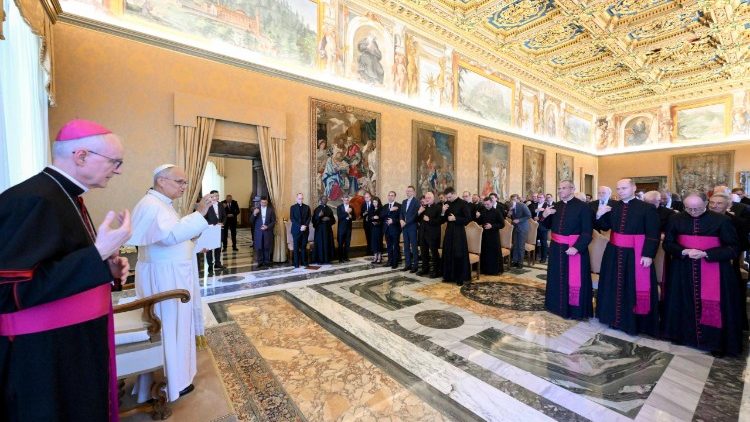
Pope Leo XIV meets with members of the Pontifical Teutonic College. PHOTO/VATICAN.
Here it reveals the cornerstone that was rejected. The Gospel reaches its climax with one of its most important images. Jesus speaks of the stone rejected by the builders becoming the cornerstone.
The rejected stone is a reference to Christ. Those who reject him may believe they are removing an obstacle, but God transforms what has been rejected into the foundation of something new.
The message is particularly significant because Jesus is speaking about rejection, suffering and ultimately his own death. What appears to be defeat will become victory.
What appears to be rejection will become the foundation. What appears to be the end will become the beginning. For Christians, this is at the heart of the Gospel: Jesus’ death does not have the final word. God brings life and salvation out of what humanity rejects.
Jesus then delivers the central warning of the Gospel: The kingdom of God is given to those who will produce its fruit. This does not mean that God’s love is something that must be earned. Rather, it means that genuine faith should eventually become visible.
A person cannot claim to belong to God’s kingdom while deliberately producing hatred, injustice, cruelty or exploitation. Faith must bear fruit. That fruit can be seen in forgiveness, generosity, honesty, compassion, humility, service and concern for the vulnerable.
The Gospel therefore moves the question from “Do I believe?” to another, more searching question: “What is my belief producing in my life?” St Paul offers the answer: Pray instead of surrendering to anxiety.
The second reading from St Paul’s Letter to the Philippians provides a strikingly different tone. After the challenging vineyard imagery and the warning of the Gospel, Paul tells Christians not to be consumed by anxiety.
Instead, he urges them to bring everything to God through prayer, petition and thanksgiving. The promise is extraordinary: God’s peace will guard the hearts and minds of those who place their trust in Christ.
Paul is not suggesting that Christians will never experience fear, suffering or uncertainty. Rather, he teaches that anxiety does not have to control the believer. Prayer changes the way Christians face their circumstances.
Instead of carrying every burden alone, believers are invited to place their concerns before God while continuing to give thanks. What should Christians think about? Paul then gives a practical guide for Christian living.
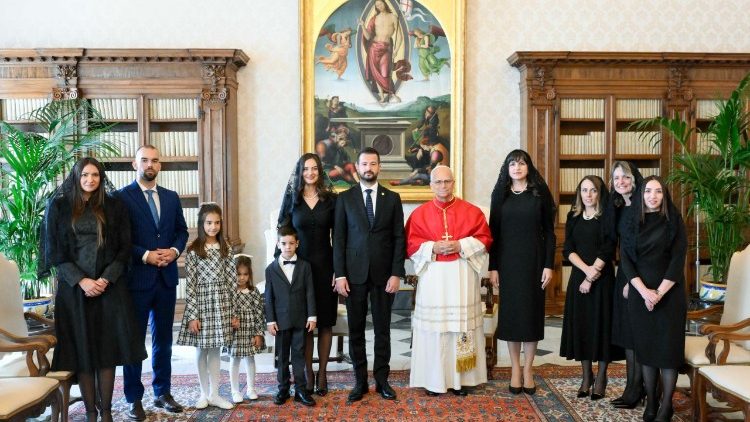
Pope Leo XIV receives the President of Montenegro and other officials. PHOTO/VATICAN.
He tells believers to concentrate on what is true, honourable, just, pure, lovely, gracious and worthy of praise. In an age filled with conflict, fear, outrage and endless negative information, the teaching is remarkably relevant.
It is not a command to ignore evil or pretend that suffering does not exist. Rather, Paul calls Christians to refuse to allow darkness to become the centre of their lives. The Christian mind should be deliberately directed towards what is good and worthy of God.
And, crucially, Paul does not stop at thinking. He tells believers to put into practice what they have learned. Christianity is therefore presented not simply as a set of ideas, but as a way of life.
Taken together, today’s readings present a coherent message. Isaiah asks whether God’s vineyard is producing good fruit. Paul teaches believers how to remain rooted in God’s peace. Jesus warns that those entrusted with the vineyard must ultimately answer for what they have done with it.
Together, they ask modern Christians to examine their personal lives, families, churches, societies and institutions. Are we producing justice? Are we protecting the vulnerable? Are we using our gifts to serve others?
Are we treating creation as something entrusted to us rather than something we may exploit without limits? Are our churches producing compassion and holiness? Are our communities producing peace? And, perhaps most importantly, is our faith producing fruit?
The warning is serious, but the door remains open. The vineyard parable contains a severe warning about rejection, violence and unfaithfulness. But the wider Christian story also reveals God’s extraordinary patience.
The owner repeatedly sends messengers. God continues to call. He continues to invite. He continues to seek a harvest. The purpose of the warning is therefore not simply to frighten believers. It is to awaken them.
There is still an opportunity to change. There is still an opportunity to return to God. There is still an opportunity for a barren vineyard to produce good fruit. The message of today’s Mass
The Gospel can be simplified into one powerful message: God has entrusted his vineyard to us. He has given us life, gifts, opportunities and his love. He now asks us to give something back, not merely words, but the fruits of a life shaped by justice, mercy, love and faith.
Christ, the Son rejected by humanity, has become the cornerstone of the Christian faith. And the challenge before believers is clear: do not merely occupy God’s vineyard; cultivate it.
Do not merely receive God’s gifts; use them for others. Do not merely speak about faith; live it. Do not allow anxiety to overwhelm you; take your fears to God in prayer. And do not allow the darkness of the world to determine what grows within your heart.
For, as today’s readings remind Catholics, God is still looking for fruit.
