

Cape Winelands Airport, the former military airfield outside Durbanville being redeveloped with an initial investment of up to R10-billion, is being positioned as far more than a new passenger gateway for Cape Town.
In responses to questions from TechCentral, the airport’s developers and partner Stellenbosch University have set out plans for an “Aerospace Village” of space and aviation companies, a dedicated drone corridor, an expanded satellite engineering centre and a suite of new aviation qualifications. Several companies have already signed letters of intent to locate facilities in the Aerospace Village.
The airport, formerly Fisantekraal Airfield, was built in 1943 as a South African Air Force base for Lockheed Ventura bombers and today serves general aviation and flight training.
Owner RSA Aero, the aviation consortium behind the project, plans a new terminal, runway infrastructure and a 450ha developable estate; Deon Cloete, previously GM of Cape Town International Airport, is the airport’s MD. Strategic partnerships with WBHO Construction and Growthpoint Properties were announced at the end of 2025, and in March architects Boogertman + Partners were appointed to lead the design alongside Berlin-based airport specialist amd.sigma, a subsidiary of Munich Airport International.
None of it exists yet, however. The site is still a working general aviation airfield surrounded by farmland: the first phase of enablement works is expected only in the final quarter of 2026, with commissioning targeted for late 2028.
Technology ambitions
Environmental authorisation, granted on 27 October 2025, survived six appeals – one was withdrawn and Western Cape environment minister Anton Bredell dismissed the remaining five in late May – but rezoning approved by the City of Cape Town’s municipal planning tribunal faces a separate appeal process, and aerodrome licensing still lies ahead. The project has been designated a “strategic integrated project” by Infrastructure South Africa, which obliges all organs of state to prioritise its approvals, licences and authorisations.
The technology ambitions attached to the project came into focus in early July, when the airport and Stellenbosch University (SU) announced a cooperation agreement covering “smart” and “green” development, including space and aviation research.
Read: Acsa is adding AI and augmented reality to its airport app
TechCentral put detailed questions to both parties about what is actually planned. Their answers sketch a project that wants to graft an aerospace cluster onto one of the country’s most ambitious private infrastructure developments – and they are frank about its status.
“It is worth being straightforward that this is intent rather than a prospectus,” said Prof Corné Schutte, vice dean: research and industry liaison in SU’s engineering faculty and the university’s lead for the partnership. But the ambition is starting to gather signatures.
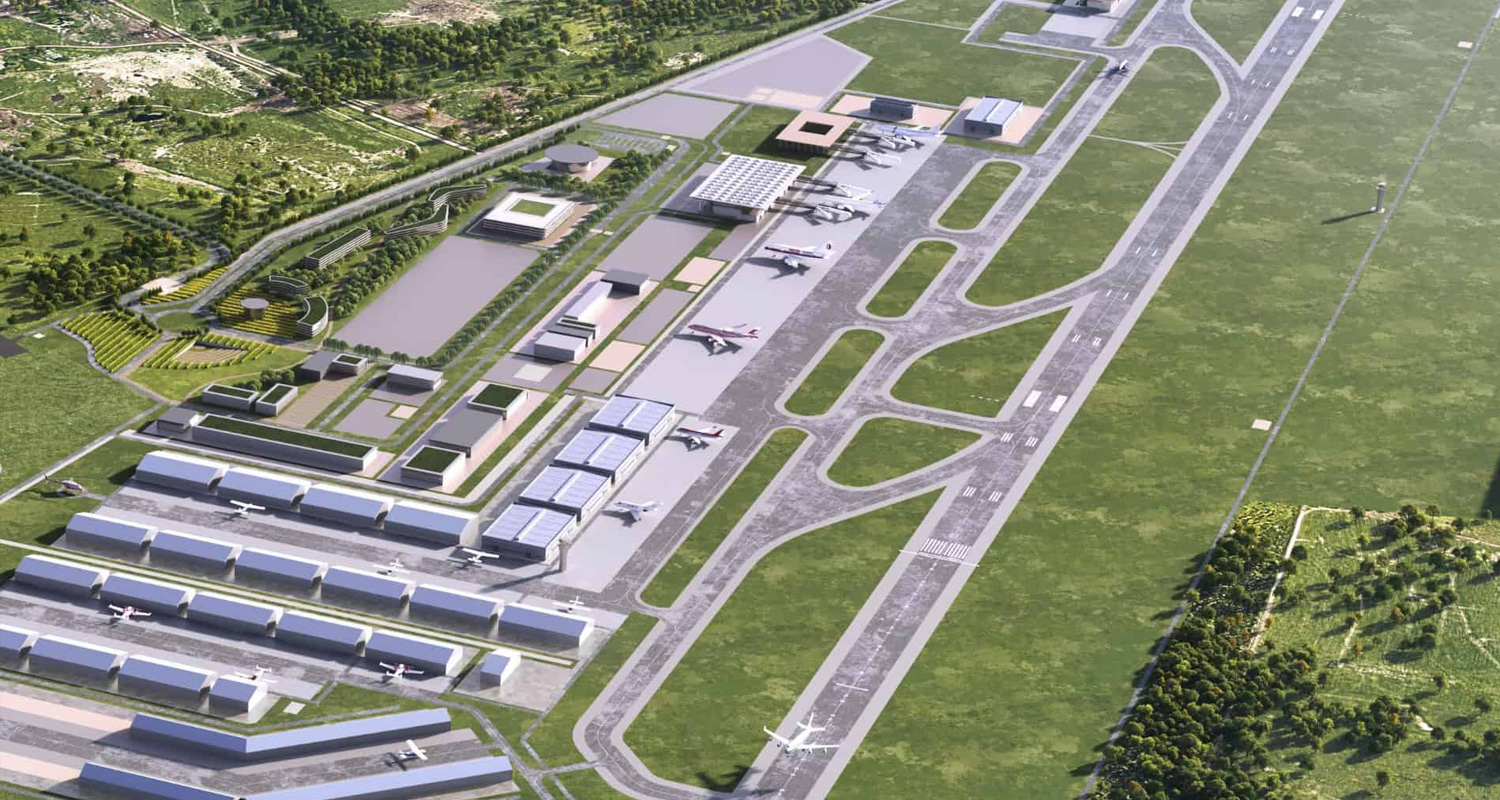
The most striking disclosure is the plan for an “Aerospace Village” next to the airport. “Cape Winelands Airport seeks to strengthen the sector by establishing an Aerospace Village adjacent to the airport,” the company’s spokesman, Deidre Davids, said, adding that it has formed an Aerospace Village Working Group Committee “comprised of representatives from academia, both locally and internationally, the private sector, government and the community”.
Asked which companies have committed to locating there, Davids said: “It is too soon to release details of names, but there are several companies which have already signed letters of intent.”
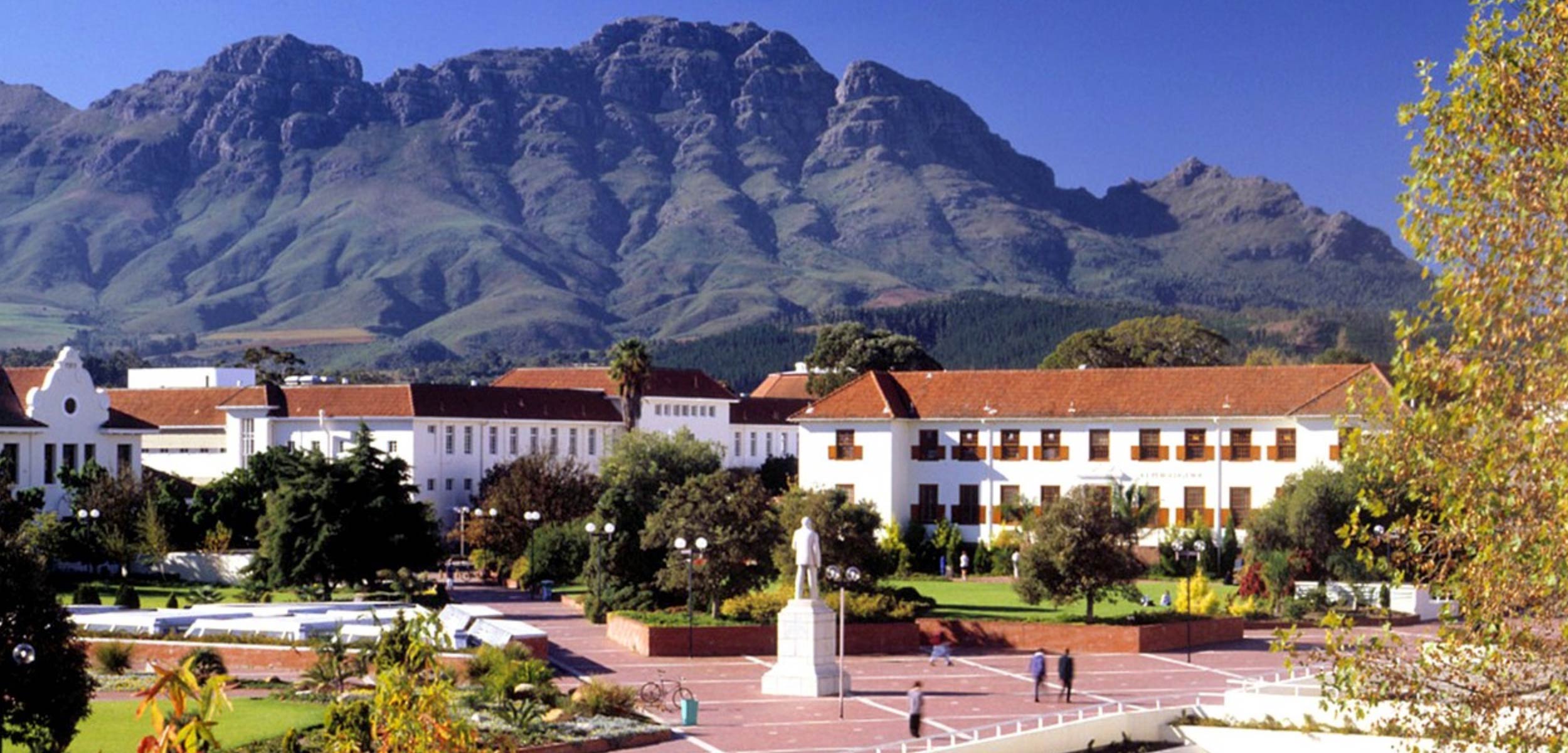
The location of the development is not accidental. The university confirmed that the vision of the greater airport area as an aerospace hub is accurate, pointing to a heritage that “runs from South Africa’s first satellite through the local satellite engineering industry that grew out of the university“.
According to Wesgro, the Western Cape in 2024 accounted for more than 55% of South Africa’s space navigation exports and nearly 94% of its spacecraft and launch vehicle exports, to markets including the US, UK, Japan, France and Thailand. The agency identifies the Somerset West to Stellenbosch corridor as a key node in Africa’s space economy, home to firms including CubeSpace, Dragonfly Aerospace and Simera Sense. The percentages deserve a caveat: Wesgro does not publish rand values for these export categories, and a dominant share of a small base is not the same thing as a large industry.
From one laboratory
The university offered a telling figure: its engineering faculty “now counts 226 people employed across its space-related spin-out companies, with a combined turnover of more than R205-million”. “That is the measure of what a single university programme has grown into,” Schutte said.
The programme in question is the Electronic Systems Laboratory, established in 1991. Out of it came Sunsat, South Africa’s first satellite, “designed and built almost entirely in-house by postgraduate engineering students” and launched on a Delta II rocket from Vandenberg, California, in February 1999. About 100 students took postgraduate degrees on aspects of the programme. “Every subsystem bar the solar panels was built by students, because at the time the alternatives were unaffordable, and that constraint turned out to be the making of them,” Schutte said.
Read: Why Stellenbosch keeps churning out successful start-ups
SunSpace and Information Systems was spun out of the laboratory in 2000 and went on to build SumbandilaSat with the university, launched in 2009 and used for disaster monitoring, including fire campaigns in the Kruger National Park.
CubeSpace, spun out of the same laboratory under the guidance of emeritus professor Herman Steyn and independent since 2017, makes attitude determination and control systems, “the technology that keeps a satellite pointed where it should be”, which “now fly on hundreds of satellites for customers in more than 30 countries and have been endorsed by Nasa”.
The airport company said the components produced in the province today include attitude and orbit determination and control systems, propulsion systems, communication systems and antennas, plus Earth observation and optical sensing equipment such as high-fidelity cameras.
The cooperation agreement envisages a revamped satellite centre of excellence at SU. “This is not a standing start,” Schutte said. “The capability has been here for more than 30 years, and the question is how we develop it further rather than whether we can build it.” The laboratory still runs a ground station, environmental and thermal-vacuum test chambers and air-bearing rigs, including one that “floats hardware on a cushion of air to simulate the frictionless conditions of orbit”.
The planned research falls into three connected strands
- The first is satellite technology itself: compact optical payloads, imaging sensors, onboard electronics able to survive the radiation environment of orbit and the testing needed to qualify components for flight.
- The second is mission engineering, assembling those technologies into complete missions, “whether the objective is monitoring crops, tracking vessels along our coastline or supporting disaster response”.
- The third is autonomy and space situational awareness: satellites that make more of their own decisions in orbit, guidance for spacecraft flying in formation and the tracking of orbital debris. “That last point is becoming urgent as the number of satellites climbs,” the university said.
Rockets, too?
On the prospect of rockets and launches, for instance from the Denel Overberg Test Range in the southern Cape, the university referred questions about the rocket development and testing programme run by the University of KwaZulu-Natal’s Aerospace Systems Research Institute (ASRI) to that institute.
But it confirmed the two capabilities are circling each other, saying it is “actively engaging with ASRI to understand how their work and our own satellite activity might align” and describing the conversations as exploratory.
Read: Acsa is adding AI and augmented reality to its airport app
“A launch capability and a satellite capability are natural complements, and it would be a missed opportunity not to at least ask the question,” Schutte said. ASRI’s rocket ambitions will be the subject of a follow-up piece.
The airport also plans a drone corridor. “As the drone industry evolves, integrating manned and unmanned aviation will become necessary, and Cape Winelands Airport wants to play a leading role in this regard,” Davids said, describing a corridor as one of the early phases of that integration and saying it will integrate with the Western Cape’s drone strategy.
“At the moment, testing a drone system in realistic conditions is one of the hardest steps between a working prototype and a commercial product,” the university said. A corridor attached to an operating airport shortens that path, it said, because systems can be flown “in real conditions, alongside real aviation activity, rather than in isolation”. For industry, “it means a route to market that does not require going offshore to find somewhere to fly”.
“Cape Winelands Airport is also committed to be a green airport from the start, this in terms of how it is built, energised and operated,” Davids said.
Renewable energy sources will include solar and biodigesters, alongside water harvesting and on-site wastewater treatment.
The airport and its architects have said the design aims to make it one of the greenest airports in the world, targeting leading environmental ratings and certifications. Asked about earlier suggestions that green hydrogen aviation fuel could feature at the airport, it offered no detail beyond those general commitments.
For Stellenbosch University, the skills pipeline is the heart of the deal. “The education dimension is, to our minds, the most consequential part of this partnership, because it is where the airport stops being infrastructure and starts producing people,” Schutte said.
The structure it has in mind is “a ladder rather than a single qualification”: short courses and microcredentials at the bottom, a taught postgraduate diploma above that, and a structured master’s with an industry research project at the top, with credits carrying upward so that “someone can enter at any level and climb”. Candidate programmes will include:
- Aviation and airport management
- Aerospace systems
- Aviation and logistics
- Unmanned aerial systems
- Sustainable aviation
The university singled out aviation and logistics as possibly the most distinctive. “An aviation and logistics programme attached to a real airport precinct with rail connections is a rarer thing.”
The reference point for the ambition is Embry-Riddle Aeronautical University in the US. “We are not partnered with them; we are looking at what they have proved is possible,” the university said. But it returned to the caution Schutte applies to the whole partnership: the cooperation agreement is a framework, and the specific programmes, their structures and their academic homes are still being worked through.
Agri-Zone
The 450ha estate will not be purely commercial and industrial. The airport said the intention is to develop “integrated, clean and healthy spaces where people can work, live, learn and play”, with housing, including for airport staff, remaining a priority.
An “Agri-Zone” is planned, focused initially on research and development “to improve farming yields and rotations”. For the university, a precinct combining commercial, industrial, residential and agricultural uses is “a live case study” in how such developments interact with surrounding communities and landscapes.
Read: South Africa shoots for space
The developers project that construction will sustain about 35 000 direct and indirect jobs, rising to just over 100 000 during the airport’s first 20 years of operation. Those are the developer’s own numbers: no independent modelling of them has been published, and job projections for megaprojects, produced by parties with an interest in the outcome, are best read as a ceiling rather than a forecast.
Whether the Aerospace Village fills up with tenants, and whether the drone corridor and satellite centre move from agreement to activity, will determine whether Fisantekraal’s second act lives up to its considerable billing. — © 2026 NewsCentral Media

