

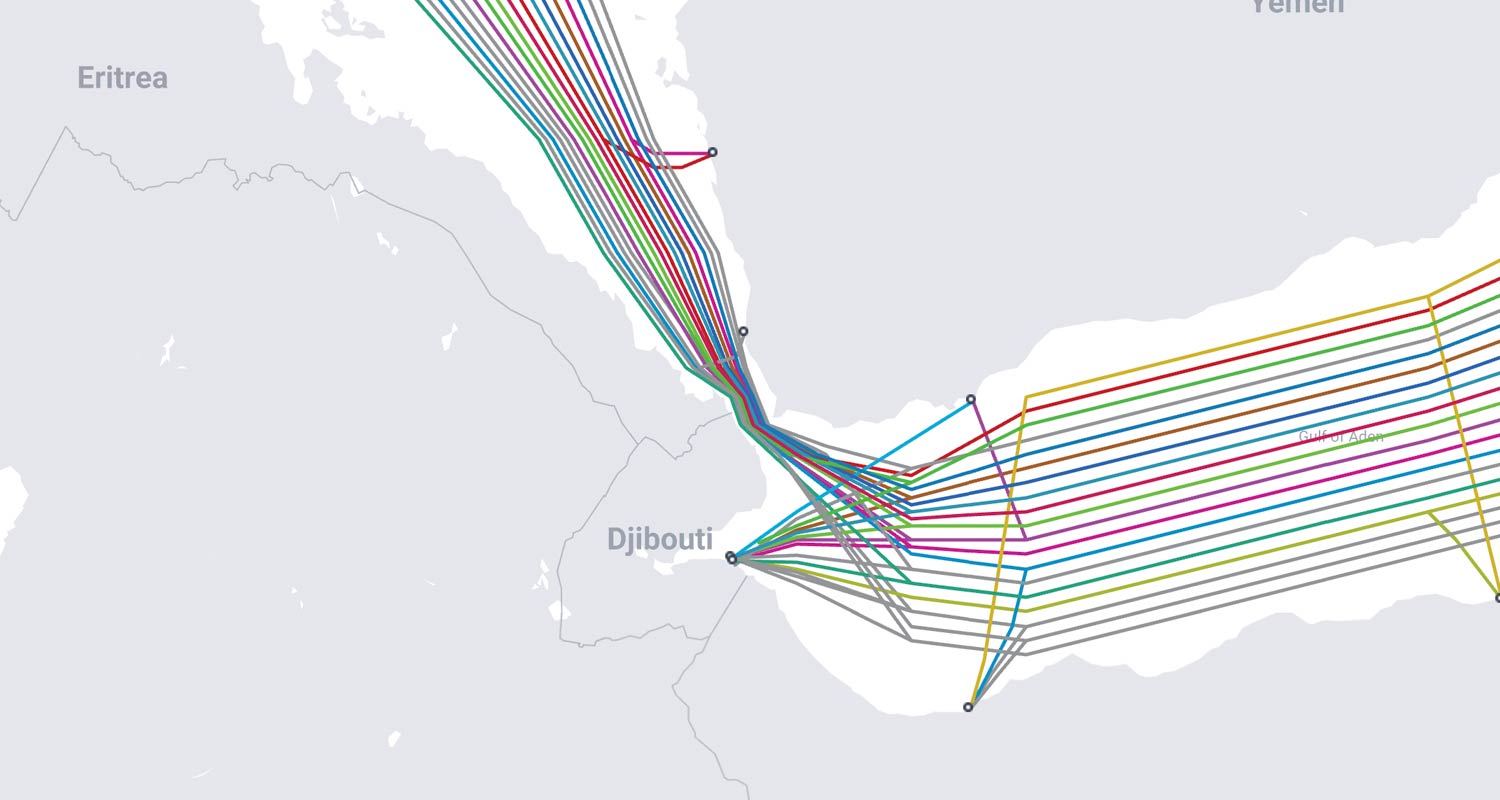
When a Belize-flagged, UK-registered cargo ship called the Rubymar was struck by a Houthi missile in the Red Sea in February 2024, it began to drift. With its anchor down in shallow water, it severed three of the region’s subsea cables before sinking on 2 March – among them was Seacom, the first privately owned subsea system to land on Africa’s east coast in 2009.
According to Richard Schumacher, MD of digital infrastructure at Seacom, the outage taught his company and the industry a lesson that all technical leaders on the continent should heed.
“I think the entire industry woke up – not just Seacom. It was really the first of many occurrences where everyone realised what disruption actually means to the worldwide internet,” Schumacher said in an interview with TechCentral.
“We’ve entered an era where our digital economies cannot afford to be down for any reason whatsoever.”
The outage cost Seacom dearly. Seacom’s contribution to majority shareholder Remgro’s headline earnings fell about 78% that financial year. Repair to the severed cables was delayed for months by conflict in the Red Sea and traffic had to be rerouted up Africa’s west coast through Google’s Equiano as well as the Peace and Wacs cables.
Geopolitical threats like the ongoing war in the Middle East continue to be a threat to connectivity in Africa, especially along the continent’s east coast. According to Paul Brodsky, senior research manager at undersea cable map specialist TeleGeography, any closure of the Strait of Hormuz would not pose a significant risk to connectivity in Africa. However, threats by Yemeni Houthi rebels in March 2026 to join the conflict, potentially bringing the closure of the Bab-el-Mandeb strait into the discussion, pose a more substantial risk. Again, redundancy via cables on Africa’s west coast has mitigated that risk significantly.
Red Sea risk
“The vast majority of Africa’s inter-regional connectivity runs to Europe, so the Persian Gulf itself is not critical to Africa connectivity. The Red Sea is extremely relevant, however. It provides a critical pathway for cables running to Europe from the east coast of Africa and from the Persian Gulf and Asia. Cable outages in the southern Red Sea are becoming more and more difficult to repair due to political instability in Yemen,” said Brodsky.
“That said, the additional cables up the west coast of Africa have proven useful, as some traffic that is normally routed up the east coast through the Red Sea has been rerouted along west coast cables.”
Read: South Africa is rapidly becoming a hyperconnected country
Seacom’s Schumacher said the redundancy at the first mile should be reflected in terrestrial middle-mile and last-mile connectivity. In South Africa, he said, the first mile is in reasonable shape. Cables land at Mtunzini in KwaZulu-Natal, and at Yzerfontein and Melkbosstrand on the Cape west coast, with multiple owners taking different geographical routes. Google’s Equiano is landing in the Eastern Cape and Seacom 2.0 is planning at least two South African landings.
The middle mile is where the gap shows up most acutely on the continent. Of the 77 subsea cable systems now touching Africa, only one sea-facing African country, Eritrea, remains unconnected – but Schumacher said the statistic flatters the picture.
“Any subsea cable system landing on a continent is useless, absolutely useless, unless you can take the traffic and data packets inland to businesses and end users. We have done well in South Africa, for example, but we still need to enable ourselves to take that traffic into the likes of Zimbabwe, Botswana, Lesotho, Eswatini and other landlocked countries,” said Schumacher.
But even where the middle- and last-mile layers exist in abundance, companies must make deliberate efforts to take advantage of them by building redundancy into their networks. Schumacher warned that for many companies, redundancy feels like an option when things run smoothly, with the need for it only becoming pronounced when a disruption occurs.
The risks are manifold, with operational, financial and reputational damage on the line. Transactions can be halted and customers frustrated, leading to losses in revenue, service-level agreement penalties, inefficiencies and long-term harm to trust and reputation.
Read: More details emerge on massive new Seacom cable
“It wouldn’t be wise for any network operator or consumer of that network to have single paths in terms of connectivity. Really what that means is having one connection into your premises. If there was a failure, and it’s a single point of failure, it could be detrimental to your operations and your business, and that is really a business risk,” said Schumacher. – © 2026 NewsCentral Media
Get breaking news from TechCentral on WhatsApp. Sign up here.

