

Capitec built its position on a bet most of the banking industry declined to make: that a customer who is poor today will be valuable in five to seven years, if their financial life develops normally. By then their income will have grown, they will have a credit history – and they will trust the bank that was there when they had nothing.
The market has rewarded that bet with a valuation of about 30x earnings, roughly three times the multiple of other South African banks. The question is whether the structural advantages behind it can survive the competitive environment now arriving.
Bet one: the poor customer becomes rich, slowly
This is not a published strategy; it is visible in the data. In the last financial year, Capitec’s fully banked clients – customers who use it for saving, borrowing and spending – grew 12% to 9.9 million. Total personal banking customers grew 7% to 25.2 million. Customers earning over R50 000/month grew 21%.
These are not new rich customers arriving from elsewhere: Capitec’s acquisition model targets the mass market. These are existing customers whose financial lives improved while Capitec held the relationship. If the trend continues, more of the base earns higher incomes, uses the bank for everything and qualifies for larger products.
The risk is that the pipeline stalls. Youth unemployment – above 60% on the expanded definition for 15- to 24-year-olds – constrains how fast young people entering the workforce generate income growth, and wage growth is not keeping pace with inflation. Or new banks steal these customers before their lives improve, before switching costs become sticky.
Bet two: branches and ATMs while everyone else closes them
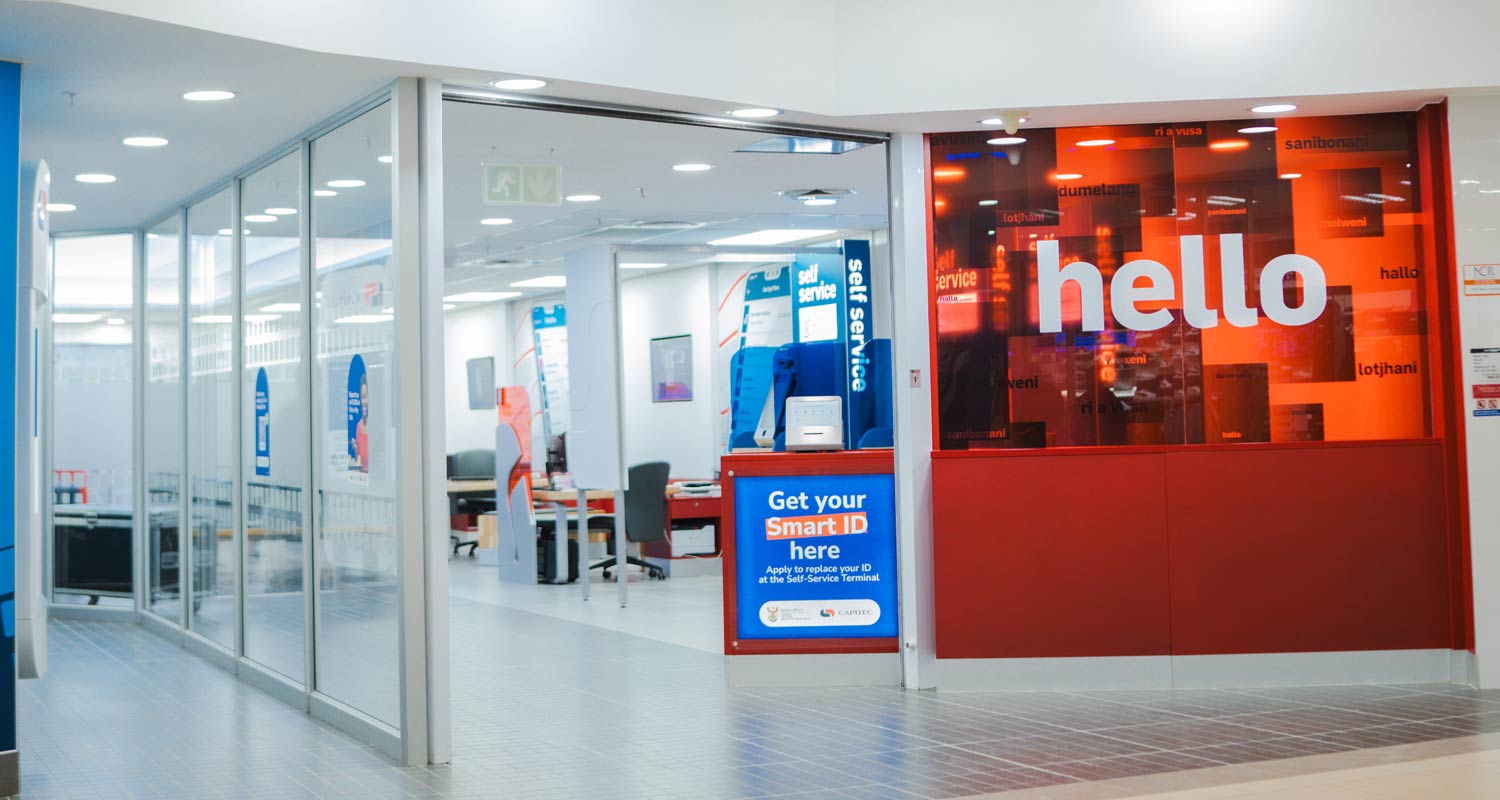
Every big bank in South Africa has reached the same conclusion: branches and ATMs are expensive, digital customers don’t need them, and efficiency runs through closure. Between 2019 and 2024, the major established banks closed a combined 8 249 ATMs – Absa 3 500, Standard Bank 3 759, FNB 990.
Capitec moved in precisely the opposite direction, adding 3 787 ATMs. Why? Because some 60% of low-income South Africans still withdraw most of their income as cash. A bank that closes its ATMs does not modernise for this customer; it abandons them.
Capitec can afford the expansion because it operates more efficiently: it spends 39c to make R1 of revenue, against 49-54c at other banks. Operating expenses rose 12% last year, but net interest income after credit impairments rose 18% and non-interest income grew 19%. A bank running at a 39% cost-to-income ratio can absorb rising branch and ATM costs in ways a bank at 54% cannot.
The space Capitec is expanding into will not stay uncontested, though. Pepkor – whose South African retail estate of more than 2 500 stores (Pep, Ackermans, Dunns, Shoe City, Tekkie Town) exceeds the branch networks of the big four banks combined – is launching its own bank in April 2027, under the working name plusb and a CEO, Merwe Scholtz, who started his career at Capitec. Its target of 1.8 million primary banked customers by 2032 is modest against Capitec’s base, but it is aimed squarely at the customers Capitec thought it owned.
Bet three: the phone as a banking window
Capitec Connect launched in September 2022 on Cell C’s infrastructure and is now South Africa’s largest mobile virtual network operator, with 1.5 million active clients – up from 900 000 a year earlier. Net income tells the story: R35-million in FY2024, R193-million in FY2025, R442-million in FY2026.
But the phone business is not primarily about connectivity. Some 80% of bundle sales happen inside the Capitec banking app, and every purchase teaches Capitec something: when customers buy data, how much they spend, what they can afford.
For a mass market client who withdraws most of their income as cash, the phone reveals what cash transactions cannot – it extends Capitec’s visibility into financial behaviour in the spaces between banking transactions. The mechanism is structural and coherent, though it cannot be verified from public sources: Capitec does not publish data on how Connect’s behavioural signals feed into credit decisions.
The risk is that this advantage only matters if Capitec owns the phone relationship – and it does not. Cell C does, including the IMSI range. Migration at scale is commercially prohibitive because the free on-net calls only work if every subscriber sits on one Cell C core.
At R442-million in annual net income, the MVNO is now materially significant – and if Cell C repriced wholesale access, or Capitec could not negotiate hard because the relationship matters too much, the entire mechanism breaks. Capitec has not publicly indicated a migration strategy. An unhedged dependency sits underneath the very mechanism that is supposed to deepen the data advantage.
Why Capitec earns less than it should
Capitec earned R16.85-billion last year – less than Standard Bank’s and FNB’s retail operations (R24.9-billion and R23.6-billion, respectively, in their most recent financial years), despite having far more customers. This paradox sits at the heart of the valuation premium. The market is betting three gaps close over time.
- Deposits: Capitec holds less than 10% of South Africa’s retail deposits despite its dominance in customer numbers. Its customers have less money to deposit, and deposits fund the lending book – a larger, stickier deposit base funds a larger, higher-yielding book at lower cost. This is the anchor; everything else flows from it.
- Banking intensity: Only 39% of Capitec’s customers use it for everything. A customer using one product generates one product’s revenue; a customer using five generates five times as much. The ratio is improving – but it is 39%.
- Type of lending: Capitec lends mainly for short-term personal needs – R5 000 for an emergency, R10 000 for a crisis – where other banks lend R500 000 for a house. Small unsecured loans are higher-risk, higher-reward, and the risk is showing: the credit loss ratio rose from 7.5% to 8.1% last year, with impairment charges up 21% to R9.98-billion – though a meaningful share of that deterioration comes from AvaFin, Capitec’s European lending acquisition, rather than its South African book. If credit losses keep rising, the growth story does not work, because the money does not come back.

None of this means the premium is wrong. It means the premium assumes the gaps close: that poor South Africans become progressively less poor, save more and borrow for bigger things – and that the bank holding the relationship from the beginning benefits most. That is a bet on economic mobility, and mobility does not happen at a consistent rate.
Capitec is a structurally different bank with a different customer base and a different economic model, and right now all three of its bets are working – the data shows it. But the foundation is fragile in one place: the phone relationship it does not control.
The structural position is real. The pressure on it is real, too. Whether the premium survives depends on whether Capitec can defend its bets while new competitors test all of them simultaneously. That is not guaranteed. It is not impossible either. It is genuinely uncertain – and it is worth watching.

