

Comsol has begun selling wholesale access to a national 5G network purpose-built for home broadband, backed by a multibillion-rand fundraising round and a shareholder overhaul that has seen Nedbank Private Equity exit the company after nine years.
Its backed by heavy-hitters, including Richard Came, one of the early investors in the business that rolled out fibre across South Africa through Vumatel.
The new network, which has a 5G core and no support for legacy technologies, will be sold only on a wholesale basis. Internet service providers, mobile virtual network operators and other resellers will set their own pricing, packaging and branding and will own the customer relationship. Comsol will not sell to consumers directly.
Asked whether that amounts to the wholesale open-access network (Woan) the state spent more than a decade trying to licence and ultimately abandoned, CEO Iain Stevenson told TechCentral in an interview: “I wasn’t going to say that. You’re welcome to say that, and that’s exactly what we’re doing.”
It is a decisive move into the consumer market for a company that has spent nearly 30 years selling to enterprises.
Nedbank Private Equity, which bought 25% of Comsol in 2016 to fund the company’s first national build, sold out in December. Two new shareholders have taken its place.
New investors
The larger is Platform Investment Partners, the investment vehicle of Came, a former Dimension Data director and an early backer of Vumatel and Dark Fibre Africa. Came’s PIP is now Comsol’s biggest single shareholder, though it doesn’t have a majority holding. The second is Wimsey Capital, a privately held investment company.
Andile Ngcaba’s Convergence Partners, a shareholder since the company’s earliest institutional funding rounds, remains invested and has put in further growth capital alongside Solcon Capital, which entered through a continuation fund created when Convergence’s original fund exited. Stevenson retains his own holding through Mactavish Investments and has invested more. RMB arranged and provided debt financing.
Read: Openserve launches its own ISP, rattling wholesale partners
Stevenson declined to give a debt-to-equity ratio. “There’s a large debt component, but there’s also a very large equity component that’s coming,” he said. “It is multibillion, as in that’s what’s being put in to deploy the infrastructure.”
He characterised the new register as “patient money, as opposed to private equity, with a long-term view on the growth prospects of the business”, and said the raise had been drawn out. “It’s been a long process for us. That’s what happens with private equity. It’s nice to get to the point where we can unleash the full potential here.”

Comsol has been building its new network for six months and says it now covers more than a million Gauteng households. The first ISP goes live on the network in September, with others to follow. Stevenson did not name the ISP.
He said Gauteng would have blanket coverage by the end of this year, with parts of the Western Cape and KwaZulu-Natal to be deployed next, followed by selected regional towns and cities. The company is targeting roughly 2 000 base stations nationally.
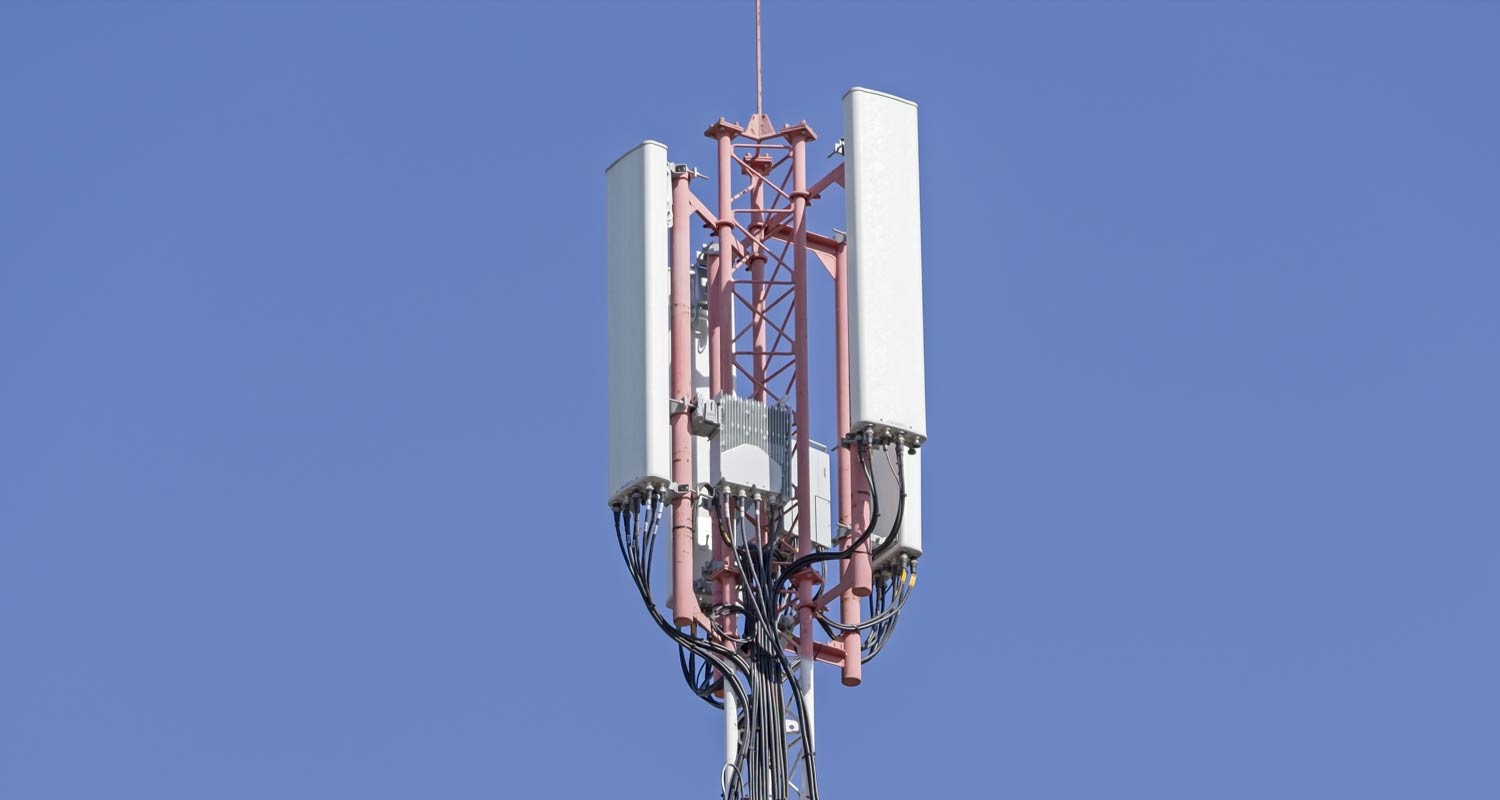
As with the enterprise network it built from 2016, Comsol is leasing towers and fibre rather than building its own. “There are thousands of towers available. We’re just choosing the right towers in the right places,” Stevenson said. He was emphatic that the build is not confined to affluent suburbs: “It’s Diepsloot, it’s Alexandra, it’s Soweto.”
The network runs on 60MHz of spectrum between 3.74GHz and 3.8GHz, sitting immediately above Rain’s allocation in the band. Comsol was one of five small operators handed access to the band by Icasa, a decision that drew criticism at the time for bypassing a competitive process. Its licence was issued in 2022.
Stevenson said Comsol’s allocation is exclusive and national. More striking is what the licence does not require. “We don’t have any roll-out obligations,” Stevenson said. Nor, he said, is there a defined renewal date. “There’s no licence renewal. It’s a clean allocation, and it’s being utilised how it’s supposed to be utilised.”
That stands in contrast to the coverage and population obligations attached to the spectrum Vodacom, MTN, Telkom and others paid billions for at auction in March 2022.
ZTE wins the build
Comsol also holds 336MHz of contiguous millimetre-wave spectrum at 28GHz, acquired in 2010 when the band attracted little interest. Stevenson said mmWave is the next capacity layer for the consumer network, with testing suggesting cell sizes comparable to those at 3.7GHz. He declined to discuss it in detail.
Comsol has chosen ZTE as its technology partner after what Stevenson described as a long evaluation in which the company tested every major vendor. ZTE won on the strength of a full turnkey offering, he said, and on its mmWave road map.
Read: Rain’s boldest – and strangest – deal yet
Comsol says the design delivers roughly double the uplink of a typical operator fixed-wireless service. Physical capacity tops out just under 1Gbit/s (the theoretical maximum speed); Stevenson said his own indoor unit at home runs at over 500Mbit/s unrestricted, though ISPs will develop their own packages, offering different speeds.
Because services are not locked to a single base station – as operator fixed-wireless products typically are – customers will be able to move a router between covered areas.
Stevenson said he does not regard fibre operators as the competition. About 15% of South African homes are connected to fibre, largely in dense metros where trenching costs can be recovered.
“There’s a massive base of people that are connected by alternate means, and there’s also a massive component of South Africa’s population that’s unconnected,” he said. He conceded Comsol could be seen as a threat by fibre operators targeting underserviced areas, where its economics are better.
The mobile operators are the clearer target. Their fixed-wireless products compete for capacity with mobile traffic.
Banks and retailers running MVNOs are explicitly in Comsol’s sights as wholesale partners.
The consumer push marks a reversal. In an interview with TechCentral in March 2023, Stevenson said Comsol had no interest in the consumer market and would not “swing blows with the mobile network operators in their corner of the room”. His answer now is that the wholesale model keeps the company out of the ring: partners take the retail fight, while Comsol supplies the road.
Whether the ISPs bite – and whether 60MHz can carry mass-market home broadband once take-up builds – is the test. Stevenson is unbothered by the capacity question. “There’s a ton of capacity on the network,” he said. As saturation approaches, Comsol will add base stations. “That’s a nice problem to have. We’re looking forward to that problem.”
Read: Comsol launches 5G network in Soweto
Alongside the consumer build, Comsol’s private networks business has grown. Stevenson said the company has deployed a private 5G network at the Port of Durban, is building one at a large mine and has a digital city project going live. That division grew out of the infrastructure Comsol first built for enterprise and IoT customers a decade ago. – © 2026 NewsCentral Media

