

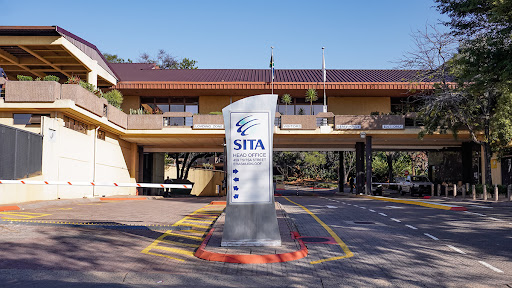
SITA’s head office in Erasmuskloof, Pretoria. (Photograph by Lesley Moyo)
The State Information Technology Agency (SITA) has begun efforts to stabilise authority vacuums within the organisation by finalising recruitment of key executive positions, Parliament’s portfolio committee heard this week.
This, as the Public Service Commission’s (PSC’s) probe of the government IT procurement’s affairs, for the period between 2020-2025, identified executive leadership gaps among theroot causes that led to instability within SITA.
This was further compounded by frequent managing director (MD) and board turnover, with the report identifying that 86% of the MD roles were acting or interim and “critically short board tenures that prevented strategic continuity”.
The report also found irregular expenditure exceeding R2 billion across four audited years, which it said signalled control failures because deterrence was absent.
An entity of the Department of Communications and Digital Technologies, SITA sits as a central pillar of government’s IT procurement. It is responsible for developing, operating and/or maintaining ICT services consumed by government departments.
See also


The entity supports over 100 government departments and public entities, counting the South African Police Service and Department of Defence among key clients.
The beleaguered entity has faced delivery and capacity challenges, with some client departments looking for alternatives.
It’s also been criticised for heavy reliance on manual systems, particularly given its mandate as the institution responsible for digitalisation and modernisation of the state.
SITA announced its first permanent MD, Magatho Mello, last December, with the new executive officially assuming office in April.
In addition, the entity’s long-awaited, nine-member board was appointed, with professor Stella Bvuma serving as chairperson. The board assumed its role on 1 June.
The board was subsequently tasked with implementing the recommendations of the PSC report, according to Bvuma.
Key among the several immediate actions was that the SITA board must submit a board-approved stabilisation and recovery plan to the minister within 30 business days.
Presenting part of the recovery plan for addressing the executive gaps, Mello told the Portfolio Committee on Communications and Digital Technologies that SITA is looking to fill six executive positions that are part of the executive committee (exco), with the role of the chief financial officer already filled as of 1 August.
Among the roles the entity is trying to fill are those of human capital management, supply chain management, executive for IT infrastructure services, as well as chief digital officer.
The MD told MPs that for the human capital management role, SITA had gone through the entire recruitment process and filled the role, but the candidate withdrew their appointment about two weeks later.
“We reopened the role, and expect that over the next three weeks, we should be looking to fill it. By mid- or end-September, we should have a complete exco appointed at least, even though one or two may be starting later.
“We’ve concluded the role of executive for supply chain. We expect the executive to start next month. This role is critical because a lot of the recommendations about our supply chain (about the efficacy and how we handle it) are what came out of the PSC report.
“The executive for IT infrastructure, we have submitted and are going through the psychometrics and the vetting. It’s a similar situation for the chief digital officer position.
“The head of legal services appointment has also happened. In the amended structure, the chief information officer (CIO) will report to the chief digital officer. Therefore, it was prudent that we appoint the chief digital officer first, and then we will appoint the CIO.”
Based on the presentation, SITA is looking to have the CIO appointed by 1 November.
On irregular expenditure, Mello highlighted that it dates back many years and is tied to the discipline of contract management. “There are multiple actions that that we’ve taken already, in terms of the discipline for that.
“What we focused on is making sure the irregular expenditure is controlled and managed, and there’s discipline and consequence management to make sure it doesn’t happen. Fundamentally, it’s around instilling discipline and confidence in the company’s processes.”

