

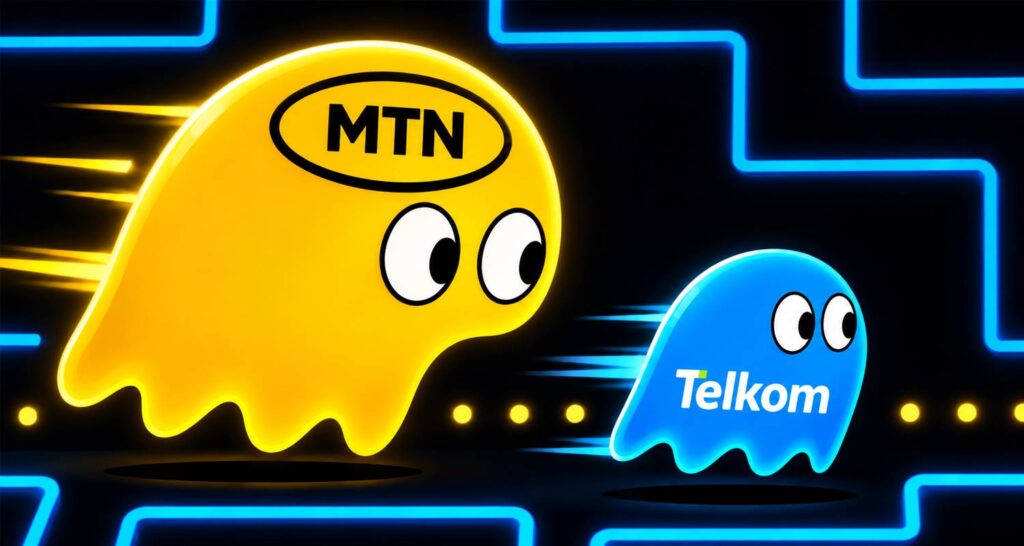
On Monday, MTN confirmed it was in talks to buy all of Telkom, and that it was contemplating paying in cash. A day later, the head of Telkom’s consumer business told analysts that South Africa’s mobile market was locked in a price war. “The competitors are starting to close the difference between their price and ours,” Lunga Siyo said.
Put those two statements side by side and at least a portion of the commercial logic of MTN’s approach is plain to see: Telkom started a price war; buying the company would end it.
For the past few years, Telkom has been the operator that rivals had to respond to. It has adopted a data-led strategy its competitors have struggled, until recently, to match. It began giving customers free calls when they bought data bundles, a “market shift” it says it initiated, and its mobile voice revenue fell 13.1% in the six months to September as a result. It now has 26.3 million mobile subscribers.
Some of that growth came at MTN’s expense. “The [loss to] Telkom is discernible,” MTN Group CEO Ralph Mupita admitted in September 2025. MTN South Africa has since shed about two million prepaid customers in the 12 months to September, which it describes as a deliberate move towards a healthier, more valuable customer base.
Loading …
None of this means MTN’s interest is cynical, or that the deal should be blocked. Telecoms is a scale game. Spectrum, 5G radio networks, fibre, backup power and the constant upgrades that customers now take for granted all demand deep pockets, and Telkom’s own results show the strain. Its capital expenditure fell 22.5% to R2.2-billion in the half, with fibre investment down 35.1%. Mobile service revenue growth slowed to 4%, from 6.4% in the first quarter alone. A price disruptor that can’t fund its network at scale won’t stay a disruptor for long.
Cell C shows where that road leads. South Africa’s fourth-largest mobile operator no longer runs its own radio network. It relies on roaming agreements with MTN and Vodacom, and this month MTN disclosed that the two had failed to agree on “certain matters” in their commercial relationship.
Take Telkom out, and the country is left with two mobile infrastructure players of scale: Vodacom and an enlarged MTN. (Rain, which has built its own network, is much more niche.) Cell C and the fast-growing virtual operators, among them Capitec Connect, compete on price, but they do so on networks owned by the very companies they are competing against. Their prices can only be as low as the wholesale terms they are offered allow.
Mupita has been open about his view that South Africa needs two, or at most three, big mobile operators. He has pointed to the merger of T-Mobile and Sprint in the US, which succeeded on its fourth attempt. But American regulators approved that deal only after the companies agreed to divest Sprint’s prepaid business, including Boost Mobile, and spectrum to Dish, so that a new fourth network could replace the one that was disappearing.
That is the model the Competition Commission and Icasa, the communications regulator, should start from. I’m no fan of regulation for the sake of it (for the most part, regulators in functioning markets should get out of the way), but approving a merger like this on a promise of good behaviour, or a pricing commitment that expires after a few years, would not be enough. If MTN wants Telkom, the remedies need to be structural.
Some of Telkom’s spectrum should go to an operator that isn’t Vodacom or MTN. And if Openserve, Telkom’s fibre business and the country’s second largest after Vumatel, ends up inside MTN, it should remain genuinely open to rival service providers, with strict conditions put in place to prevent abuse. Vodacom already co-controls Vumatel’s parent, Maziv. A market in which the two biggest mobile operators also own the two biggest fibre networks may need more than goodwill to stay competitive.
Mupita may well be right that South Africa can’t sustain three or four mobile network operators. But consolidation has a price, and someone will pay it.
None of these conditions should put MTN off. They would add to a bill that already starts at the more than R30-billion Telkom was worth ahead of the announcement about the latest talks, plus whatever premium a cash offer demands.
The deal carries real risks for MTN, too. Transactions like this take years: Vodacom’s purchase of a stake in Maziv took nearly four years to close, after the Competition Tribunal initially blocked it. And that deal was not as complex as this one would be. A drawn-out pursuit would also risk pulling management attention away from day-to-day operations.
Staff at both companies would face months, perhaps years, of uncertainty, and Telkom’s unions are likely to demand assurances on jobs. Rivals would be free to poach customers and talent in the meantime.

Then there is culture. Folding a former state monopoly, with its own history of labour relations and government oversight, into a commercially driven multinational will not be easy.
Mupita may well be right that South Africa can’t sustain three or four mobile network operators. But consolidation has a price, and someone will pay it. If the regulators set the right conditions, MTN will. If they don’t, it will be the customers who switched to Telkom for cheaper data, only to find no one left to undercut the big two. – (c) 2026 NewsCentral Media
- The author, Duncan McLeod, is editor of TechCentral

