

Nearly 1,000 people were arrested in nationwide protests in France, Interior Minister Laurent Nuñez said Saturday, after demonstrations over the high cost of living and the country’s education system earlier in the day remained largely peaceful.
Nuñez said the number of arrests is expected to rise significantly. He said marches “passed off well” in cities, but police officers found themselves confronted with “an extremely elevated level of violence” from “ultra-left” groups later in the day. Nuñez said some shops and businesses had been looted, but “the scale was far smaller” than a week earlier, when some 3,000 businesses were damaged or looted.
He said police acted more rapidly and conducted more pre-demonstration checks. Businesses and shopping centers had also been better protected. Earlier Saturday, the interior minister said police had confiscated weapons including metal balls, lead pellets, fireworks, slingshots, steel balls, improvised weapons, a katana and airsoft weapons, he said.
The French Interior Ministry said about 410,000 people participated in about 298 protests around the country. Union organizers from the General Confederation of Labor put the number at around 800,000. An explanation for the discrepancy was not immediately available.
Aris MESSINIS /AFP via Getty Images 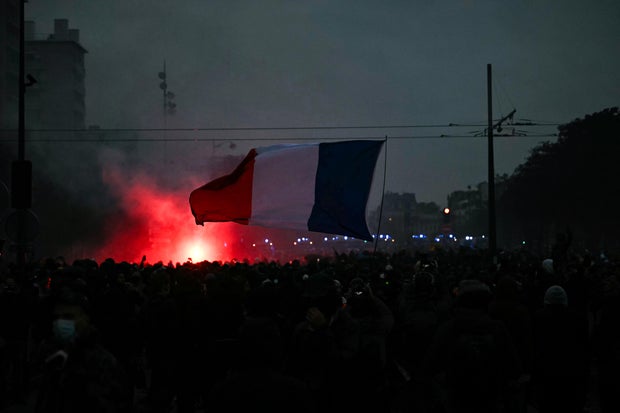
Some confrontations were reported between authorities and demonstrators in several cities, but as of Saturday evening there had been no repeat of the major street violence and rioting that erupted amid similar protests last week.
Nuñez previously said that French authorities were preparing to maintain order this weekend by maintaining up to 70,000 officers nationwide along with assets including helicopters, armored vehicles and water cannons.
Nuñez said authorities will remain “on high alert” overnight and into Saturday.
Clashes break out in Paris after largely peaceful march
Paris had prepared for unrest, with shops boarded up and events including those related to the NFL’s first French football game canceled, but authorities described the atmosphere in the city as “calm.”
Thousands gathered at the Porte d’Italie on the city’s southeastern rim for an authorized demonstration. The march had originally been set for the Bastille, near the city’s center, and was changed to the more remote Porte d’Italie at the last minute. Union representative Murielle Guilbert told reporters that it was “scandalous” that Macron had forbidden protesters from demonstrating “where we wish to demonstrate,” but participants complied with the change.
Thibault Camus/AP 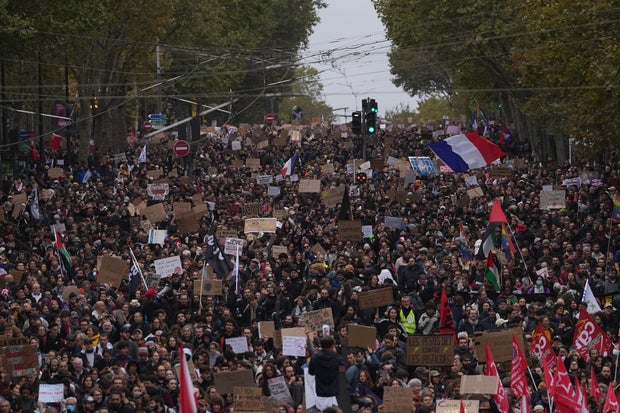
The front of the march ended without incident. Some chanted “We are not happy” as they peeled away from the Porte de Vincennes. Police said 110,000 people participated in the event, while union members put the number at 250,000.
As the evening went on, clashes were reported between police and demonstrators, the Agence France-Presse reported. Nuñez said that “several thousand radical activists” had “gathered at the rear of the march, including around 500 individuals identified as rioters.”
Clashes between protesters and police lasted about two hours, he said.
The Paris prosecutor’s office said 64 people, including six minors, were arrested and 40 were placed in police custody. Most arrests concerned suspected weapons offenses or participation in a group preparing violence or property damage, the office said. More than 3,000 were stopped and checked by officers, police said.
Aris Messinis /AFP via Getty Images 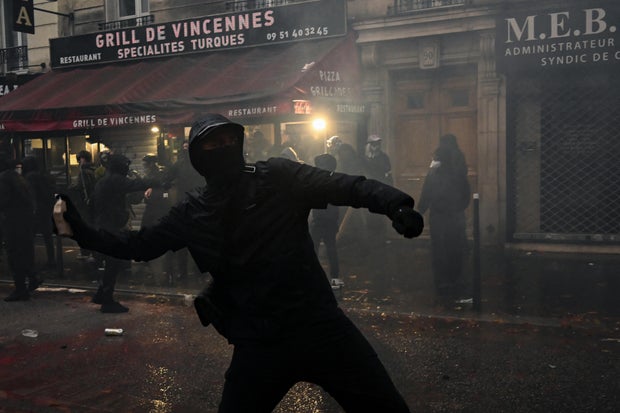
Protesters march against far-right gathering
In Orleans, thousands of people marched against a congress held by Marine Le Pen’s far-right National Rally party. Le Pen is launching her campaign to succeed Emmanuel Macron as France’s president. Elections will be held in six months, and surveys show Le Pen is best-placed to win. Demonstrators in Orleans protested both Macron and Le Pen.
“Macron resign. Le Pen in prison,” the crowd yelled, according to the AFP. Police put their numbers at 11,000, while organizers said 26,000 took part. About 50 organizations, including labor unions, left-wing parties and student groups, had called for a protest against Le Pen’s nationalist, anti-immigration party.
Romain Gautier / Hans Lucas / AFP via Getty Images 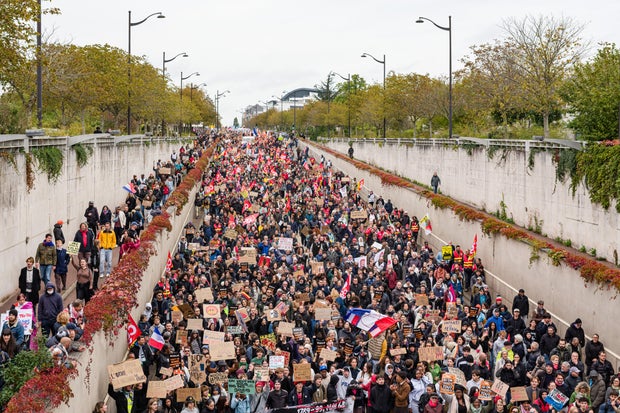
Some placards seen at the march referenced a shooting in Trappes, a Paris suburb, that left one person dead and several others injured across several locations. Macron called the rampage a “racist terror attack.” Prosecutors are investigating the shooting as a terrorist incident.
French media reported that the protest against the congress ended peacefully early Saturday afternoon. The gathering is expected to continue through Sunday.
Protesters and police clash in smaller cities
Demonstrations had been banned in the southeast city of Lyon, but about 150 protesters near the city’s center briefly tried to block a road. Police fired tear gas to disperse the group. Tear gas was also used to break up a group of around 1,000 people gathered in the south of the city. Street fires were also reported.
A police helicopter was seen flying over the city, and security forces, armored vehicles and riot police vans were patrolling. A 21-year-old student, who spoke to the Agence France-Presse on the condition of anonymity, described authorities as “really mobile.”
In the western city of Nantes, thousands of protesters broke through police lines to enter the city center, the AFP reported. Officers used tear gas and a water cannon to try and disperse them. Some on the fringes of the demonstration threw projectiles and aimed fireworks at officers.
Mathieu Prudhomme/Anadolu via Getty Images 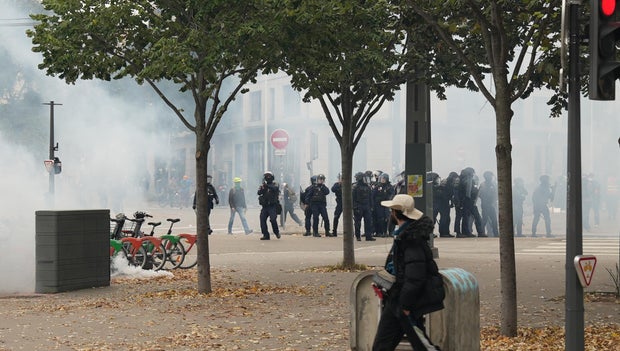
Police said about 17,000 attended an event in Marseille. Officers fired tear gas during clashes with several dozen people near the march’s endpoint. Street fires were seen in the city.
Tear gas was also deployed in Clermont-Ferrand, Bordeaux and Strasbourg, police said. Nuñez said one person was seriously injured in Clermont-Ferrand, but did not provide any details.
In the city of Toulouse, a 20-year-old man reportedly had fingers blown off, Nuñez said. He did not provide more details about the person, their condition, or how they came to be injured.
Nuñez said that in the southern cities of Cannes and Montpellier, authorities saw far-right activists who claimed they were there to protect businesses or sought confrontations with “ultra-left militants.” He said it was the first time authorities witnessed this phenomenon.
Matthieu Rondel /AFP via Getty Images 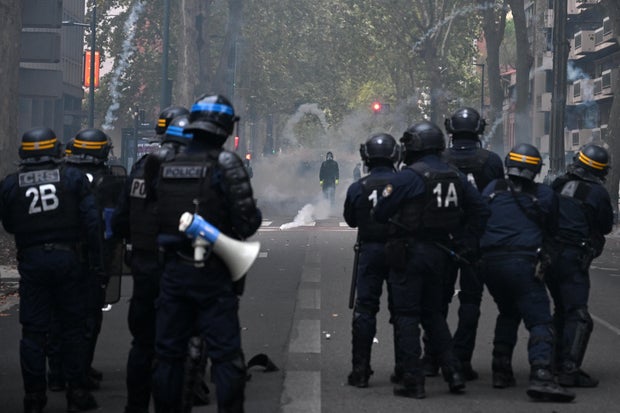
In Nice, where demonstrations had also been banned, 11 people were arrested after far-right extremists fought with demonstrators downtown, regional authorities said. Water cannons were also used in the city.
Organizers call for Halloween demonstrations
One group of protesters, the Yellow Vests, said they would hold another round of protests on Oct. 31. The Yellow Vests emerged about eight years ago as a loosely organized group that staged disruptive protests against Macron.
Organizers called for rallies and a sit-in outside parliament and city halls nationwide, condemning the “authoritarian drift” of Macron’s government and urging citizens to stand up for “public freedoms.”
The demonstrations have been ongoing since September, when high school students in the southeast of Paris protested for better conditions. The unrest quickly spread across the country as people took to the streets to demand relief from rising living costs.
Jean-Francois Badias/AP 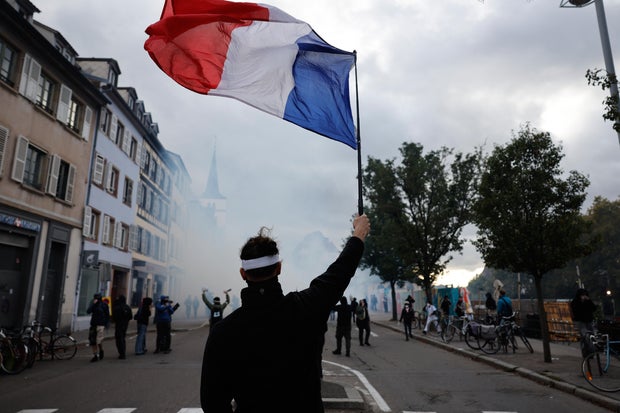
More protests spread across Europe
Other protests took place across Europe on Saturday, encompassing a broad range of issues including pensions, housing costs, anti-war movements, education and corruption.
Italian police said in a statement that they carried out nine arrests and briefly detained 371 people during protests in eight cities on Saturday. Of the people who were detained and taken to police stations, 110 were minors, the statement said.
Soldiers were deployed to Milan, the nation’s fashion and finance capital, ahead of fresh demonstrations one week after looting and police clashes. Many stores were boarded up with wooden planks on Saturday. Premier Giorgia Meloni announced a raft of measures, including sending an additional 500 soldiers to Milan and tougher penalties for minors, who police said made up a large part of the violent protesters.
In Rome, authorities locked down luxury shopping streets and stepped up patrols around key sites. Several hundred students demonstrated peacefully in the historic city. Organizers of peaceful events sought to distance themselves from potential unrest, urging participants to keep their faces uncovered and their hands visible.
Andrea Carrubba/Anadolu via Getty Images 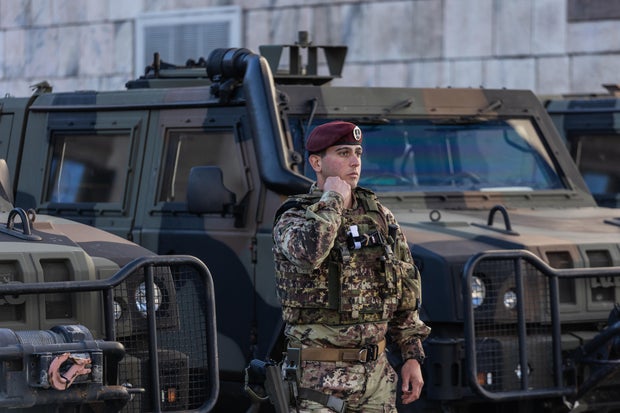
In Albania’s capital of Tirana, riot police used water cannons to subdue large groups of protesters. Some of the demonstrators threw projectiles at police, the AP reported. A separate protest organized by the opposition outside the office of Prime Minister Edi Rama turned violent earlier Saturday, with some activists lighting fires on the street. The demonstrators are mainly high school and university students, demanding lower tuition fees, greater state investment in education and protesting corruption in the education system. A broader anti-government movement is calling for Rama’s resignation.
In Spain, thousands of retirees and others marched through central Madrid to demand that public pensions aren’t meddled with.
Protesters in Lisbon, Portugal, are expected to march across the city Saturday to demand affordable housing.

