

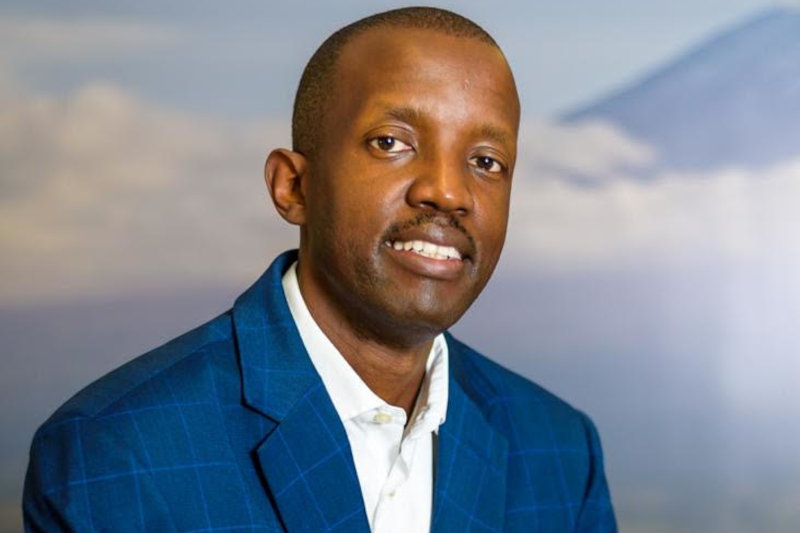
Richard Okello
Our new book, How we made it in Africa II: Real stories of entrepreneurs turning opportunity into profit, is available here.
Interview with Richard Okello
FOUNDER, SANGO CAPITAL
Lives in: Johannesburg, South Africa
Africa-focused investor Richard Okello compares investing on the continent to riding a speedboat through rough seas while trying to drink a glass of wine without spilling a drop. The job is to get from point A to point B with the liquid intact.
In 2011, Okello established Sango Capital, which now manages just under $1 billion. How we made it in Africa editor-in-chief Jaco Maritz spoke to him about the realities of putting capital to work on the continent.
Topics discussed during the interview include:
- Rethinking risk in Africa
- High-potential countries
- Industries offering the best upside
- Navigating the toughest aspects of the job
- Sango Capital’s biggest investment wins
Watch the full interview below:
Richard Okello was born in Kenya, but grew up in Uganda. A scholarship then took him to Wales, where he attended high school at the United World College of the Atlantic. From there, he moved to the United States to study at Swarthmore College, just outside Philadelphia.
Okello began his foray into investing in the US at famous investor Ray Dalio’s Bridgewater Associates. He joined when the hedge fund was relatively small – managing less than $1 billion – and stayed for about nine years as it scaled significantly.
Following Bridgewater, Okello transitioned to Makena Capital, a San Francisco-based investment firm. Later in his tenure at Makena, he helped steer the firm’s first investments in Africa.
That experience paved the way for his next move: launching his own Africa-focused investment shop, Sango Capital.
Today, Sango raises money from international investors – particularly North American endowments, foundations, family offices, and pensions. It then invests that capital into African private equity, venture capital, and private debt funds, while also making direct investments in local companies.
Standout investments
One of Sango’s standout investments has been Sundry Markets, the parent company of Marketsquare, a Nigerian supermarket chain founded by entrepreneur Ebele Enunwa. (Our first book tells the in-depth story of how Enunwa built his business. It is available here).
Despite the steady rise of air-conditioned malls and modern grocery chains, roughly 90% of retail transactions in Nigeria still flow through informal channels – a vibrant ecosystem of roadside stalls, open-air markets, and hawkers weaving through gridlocked traffic.
Yet, as Okello notes, a growing number of Nigerians increasingly prefer the convenience of organised retail over haggling at informal markets. Anticipating that shift paid off: Sango partially exited its stake in Sundry Markets a few years ago, securing what Okello describes as a “very high” dollar multiple on the investment.
Another profitable investment for Sango was CMGP, a Moroccan agricultural supplier. The company provides farmers with everything from irrigation systems and water pipes to seeds and fertilisers. It went public on the Casablanca Stock Exchange in December 2024.
Mapping the opportunities
When asked where he sees the most promise, Okello points to Egypt, which he describes as “very intentional about becoming a middle-income country”. A key advantage is its population of some 120 million. For businesses, that means a vast market where they can achieve significant scale without ever crossing a border. Thanks to large-scale recent investment, he expects Egypt to soon eclipse South Africa to become the continent’s biggest economy.
The investor is also cautiously optimistic about Nigeria following a series of reforms. Specifically, he highlights the removal of a fuel subsidy that previously cost the government billions of dollars a year, and the move to allow the local currency to devalue sharply, as much-needed corrective measures.
He is equally upbeat about Côte d’Ivoire. The world’s largest cocoa producer has been one of the continent’s fastest-growing economies, averaging more than 6% annual growth over the past decade.
South Africa presents a different kind of opportunity. Okello concedes its broader economic outlook is subdued – a reality underscored by the IMF recently lowering its 2026 growth forecast to just 1.0% due to geopolitical shocks in the Middle East. Yet the country boasts a strong private equity sector, deep markets and seasoned corporate operators. He contrasts this with Ethiopia. Despite posting robust annual growth of nearly 8% over the past decade, Ethiopia’s relatively shallow private sector offers far fewer opportunities for a firm like Sango.
Turning to East Africa, he sees solid potential in markets like Kenya and Tanzania. While acknowledging some political uncertainty in Tanzania, he expects the country will “probably surprise on the upside” because the government is “doing a lot of big things”. A prime example is a $10 billion railway project designed to link the port of Dar es Salaam to Lake Victoria, and eventually to landlocked neighbours including Rwanda, Uganda, and the Democratic Republic of Congo. With several sections already complete, the network is poised to overhaul the region’s freight transport.
While also bullish on Morocco, the Sango managing partner warns that assets there are getting expensive. Valuations are likely to rise even further as the country prepares to co-host the 2030 football World Cup alongside Spain and Portugal, driving a surge in local investment. “To make money, you have to be able to buy things at the right price,” he says. “You could do that sometimes in Morocco but it’s getting harder.”
Promising sectors
On a sector level, Okello is particularly keen on African retail. “The transformation from unorganised retail to organised retail is underway,” he notes. He additionally sees significant upside in fast food, an industry propelled by rapid urbanisation.
Private healthcare presents another promising avenue, from pharmacies to clinics dealing with conditions like diabetes and high blood pressure. “As African wealth rises, those diseases move in and you have to have service providers for them,” he explains.
Okello is also upbeat about the technology sector across both early and growth stages. He points to platforms addressing online education, digital payments, and the onboarding of unbanked small traders into the formal financial system as attractive areas.

