

Eskom on Tuesday launched Eskom Green, a dedicated renewable energy business that the utility says will scale solar, wind, hydro and storage to as much as 32GW by 2040, with its leadership insisting the new unit will work with private developers rather than crowd them out.
The launch caps a turnaround that Eskom executives returned to repeatedly during the event. Group CEO Dan Marokane said the utility had moved from “struggling to keep the lights on, and struggling financially” three years ago to meeting demand “100%” of the time, and that renewables were the natural next step to keep the lights on.
Marokane described Eskom Green as one pillar of a refocused business model alongside generation, transmission and distribution, telling the audience in Sandton: “We are catching up to getting to be where we belong. We hope you will celebrate with us today, and be ready to engage with us in Eskom Green.”
Rivoningo Mnisi, group executive for renewables and the man now in charge of Eskom Green, set out the unit’s ambition in blunt terms. “The objective is very simple: to make renewables viable for South Africa at scale,” he said, with Eskom Green targeting 32GW of renewable power by 2040.
Mnisi said Eskom Green was established as part of the utility’s unbundling and was built to answer a clear customer need. “It is a response to what we know South African customers want, which is affordable, available and increasingly clean energy,” he said. The portfolio would span hydro, solar and wind projects, with a strong additional focus on battery and pumped storage.
Consistency
“The challenge is consistency: solar is not there at night, wind fluctuates and both can introduce instability. That is why we need a combined, diversified offering with good storage solutions to provide a sustained energy solution.”
On delivery, Mnisi stressed partnership with independent power producers (IPPs) and financiers. “No single organisation can deliver the needs alone,” he said. “Eskom Green is designed as a partnership platform. To deliver at scale we need to work with the market, partnering with IPPs and financiers to deliver projects that are efficiently structured, well governed and executed at the highest standard.”
Read: Eskom turned the lights back on – now finish the reforms
The approved target is 5.6GW by 2030, ramping up to 21GW by 2035 and 32GW by 2040. On cost, Mnisi said Eskom Green would not be a premium product. “We are looking at market-aligned pricing, because we need to produce power affordably.”
He described Eskom’s existing footprint as a decisive edge. “Eskom has access to land where grid infrastructure already exists, and we can connect our renewables there directly. That is an advantage,” he said. “Developing projects close to existing power infrastructure gives us a unique ability to scale realistically and sustainably.”
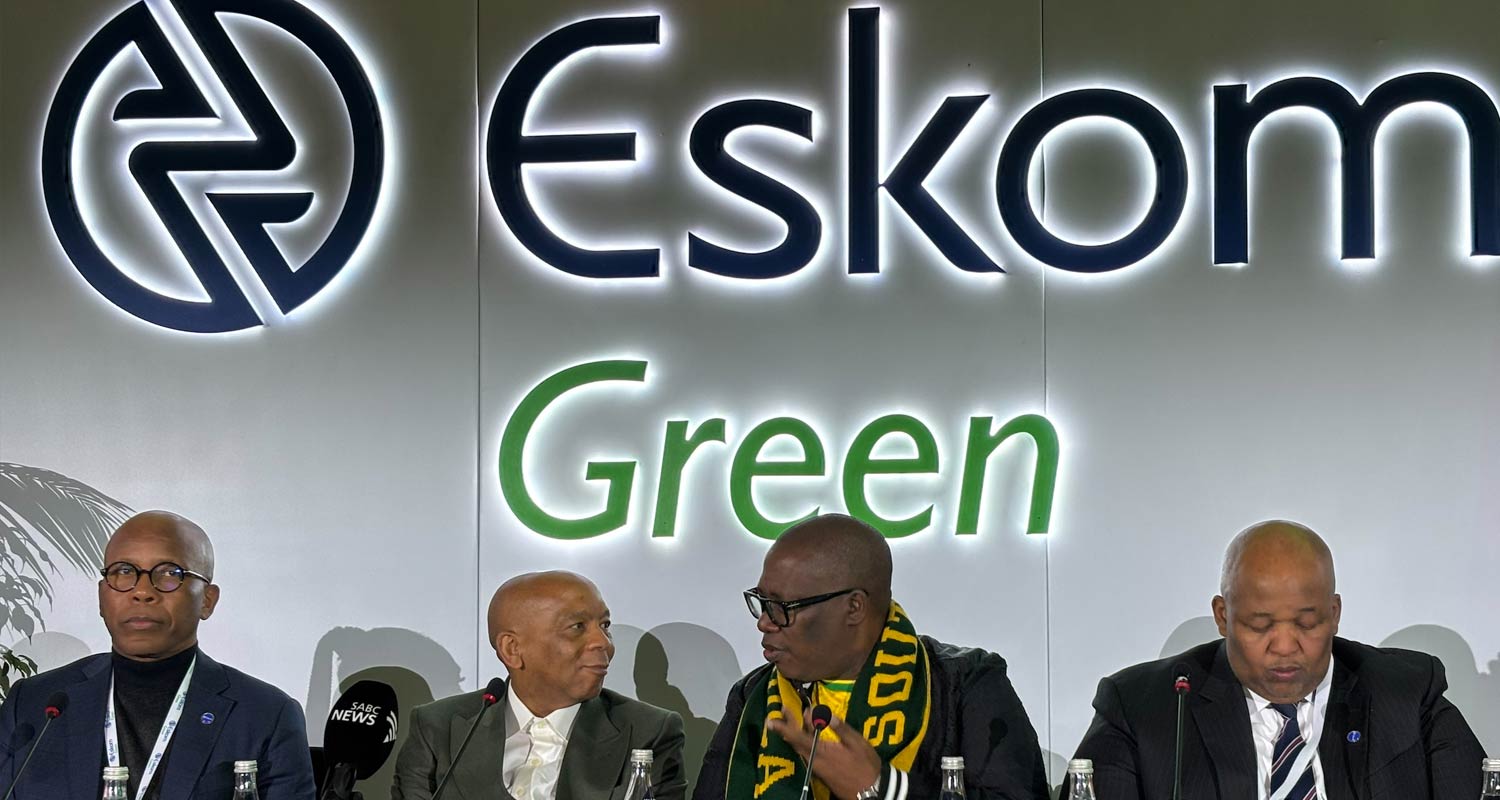
Board chairman Mteto Nyati used his address to confront head-on the concern that Eskom Green could crowd out private renewable developers. “We are aware of concerns that Eskom Green could crowd out private renewables. We respect that perspective, but we see it differently,” he said. “Eskom is not entering this space to replace others. Given our scale and responsibility for the national grid, we believe we bring capabilities that complement rather than compete with the market.”
Nyati said the board’s intent was “to de-risk the energy transition, to allow all of the power producers to succeed together”, adding that existing agreements with IPPs now exceeded 2GW. He recalled that three years ago “there was no plan for renewables, there was a feeling in the country that Eskom had no future”, and said the board was now “convinced Eskom has a big role to play in South Africa’s just energy transition”.
“This is not just about announcements, but practical energy generation,” Nyati said. The R1.2-billion, 75MW solar plant alongside the Lethabo coal-fired power station in Metsimaholo in the Free State is the first project to break ground under the Eskom Green banner. Once at full production it is expected to generate roughly 147GWh/year, enough to supply about 60 000 households. “Eskom Green represents a measured and strategic contribution to South Africa’s energy future,” Nyati said. “This is an Eskom that wants to do the right things right.”
Coal stays, but ‘we are addressing’ emissions
Electricity and energy minister Kgosientsho Ramokgopa said the shift to renewables did not signal the end of coal. “Coal remains, that is a policy of the South African government,” he said. “We have just completed Medupi and Kusile – coal will remain foundational. We do not have a coal problem, we have an emissions problem, and we are addressing that problem.”
Ramokgopa said South Africa was one of the five best regions on Earth for solar and that Eskom had to exploit that economic opportunity. He promised that the “single biggest energy partnership in the southern hemisphere”, covering solar and battery installations, would be announced within two weeks, alongside provincial projects.
Read: Moody’s flags risk in Eskom grid split
The minister mounted the firmest defence of state-led renewables, pushing back on the crowding-out argument with what he called the evidence. “When things were at their worst with load shedding, the critics said the market will solve the problem of Eskom’s lacking generation and maintenance issues. It did not,” he said. “With renewables again, Eskom needs to be the foundation of energy for South Africa, a guarantor of clean electricity for the country. It is the state that must answer the call.”
His message to Eskom echoed the approach he said had ended load shedding. “Focus on execution, and leave the politics to me,” Ramokgopa said. “Eskom has said what they are doing. So IPPs are invited to come forward with their own plans to contribute. This is not a competition, but a chance for collaboration.
“This is Eskom 2.0. We are getting this house in order. This is going to be an efficient machine. Once it is at full throttle, it will be unstoppable.”
On Eskom’s past form, delivery will be the real test. — © 2026 NewsCentral Media

