

COP17 | UN biodiversity talks enter critical phase as delegates clash over funding and indigenous rights
From L-R: CBD Deputy Executive Secretary Jihyun Lee; Christine Estrada, CBD Secretariat; and COP 17 President Hambardzum Matevosyan, Minister of Environment, Armenia. PHOTO/ IISD/ENB – Mike Muzurakis.
By PATRICK MAYOYO
As the 2026 United Nations Biodiversity Conference entered its final stages, delegates made progress on biodiversity conservation, biosafety and access to genetic resources, but disagreements over funding, agricultural practices and Indigenous Peoples’ participation continued to complicate negotiations.
Working Group I considered issues under the Nagoya Protocol on Access and Benefit-sharing (ABS), while Working Group II addressed the Cartagena Protocol on Biosafety and the Convention on Biological Diversity (CBD).
Contact groups also convened to discuss risk assessment and management of living modified organisms, the financial mechanism, areas of further work under the Kunming-Montreal Global Biodiversity Framework (GBF), and Article 8(j), which recognises the contributions and knowledge of Indigenous Peoples and local communities (IPLCs).
An evening stocktaking plenary heard reports, addressed organisational matters and adopted decisions on several issues under the 17th Conference of the Parties to the CBD (COP 17), the 12th meeting of the parties to the Cartagena Protocol (CP-MOP 12) and the sixth meeting of the parties to the Nagoya Protocol (NP-MOP 6).
Under the Nagoya Protocol, delegates approved a revised text on monitoring and reporting following a minor amendment.
Discussions on assessment and review produced agreement on encouraging countries to develop guidelines for users and make community protocols and access and benefit-sharing procedures available through the ABS Clearing-House.
Delegates also agreed to encourage the use of existing tools, including model contractual clauses and codes of conduct, while strengthening engagement with Indigenous Peoples, user organisations and other stakeholders.
However, provisions concerning the global multilateral benefit-sharing mechanism remained unresolved, with several paragraphs referred to a contact group for further consideration.
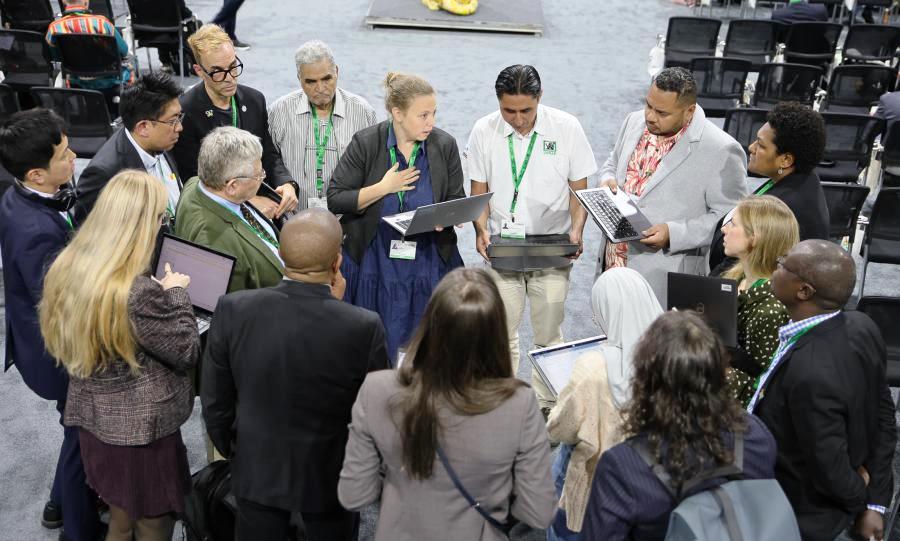
Delegates trying to find common ground on the margins of Working Group I. PHOTO/ IISD/ENB – Mike Muzurakis.
Negotiations on enhancing implementation also exposed divisions over whether to retain references to Article 10 of the Nagoya Protocol and how to frame cooperation between international environmental agreements. The text was approved with disputed provisions left in brackets.
On financing, delegates agreed to recommend that the Conference of the Parties ask the Global Environment Facility (GEF) to consider providing adequate, accessible and predictable funding for implementing the Nagoya Protocol, taking account of national priorities and the special needs of least developed countries and small island developing states.
Under the Cartagena Protocol, parties made progress towards strengthening predictable and dedicated financing for biosafety and simplifying access to funding for eligible countries.
The proposed recommendations call on the GEF to improve funding arrangements to support the full and effective implementation of the protocol, while taking into account the needs of vulnerable countries.
Under the Convention on Biological Diversity, delegates made progress on biodiversity and agriculture, agreeing on language encouraging countries to integrate the conservation, restoration and sustainable use of soil biodiversity into national planning instruments, in line with relevant GBF targets and national circumstances.
They also backed stronger coordination between agricultural, environmental and health sectors, with an emphasis on technical assistance, rural extension services and the participation of farmer organisations, particularly smallholders, family farmers and agroecological producers.
The Secretariat was invited to work with the Food and Agriculture Organization of the United Nations, building on existing initiatives and avoiding duplication. Delegates also supported continued efforts to develop harmonised methodologies for monitoring soil biodiversity, prioritising data from national soil monitoring systems.
However, consensus remained elusive on financial support for soil biodiversity research and monitoring, reforming subsidies and incentives harmful to biodiversity, and cooperation on capacity-building.
Disagreements also emerged over references to pollution and its effects on soil biodiversity, prompting the chair to establish a Friends of the Chair group to resolve outstanding issues.
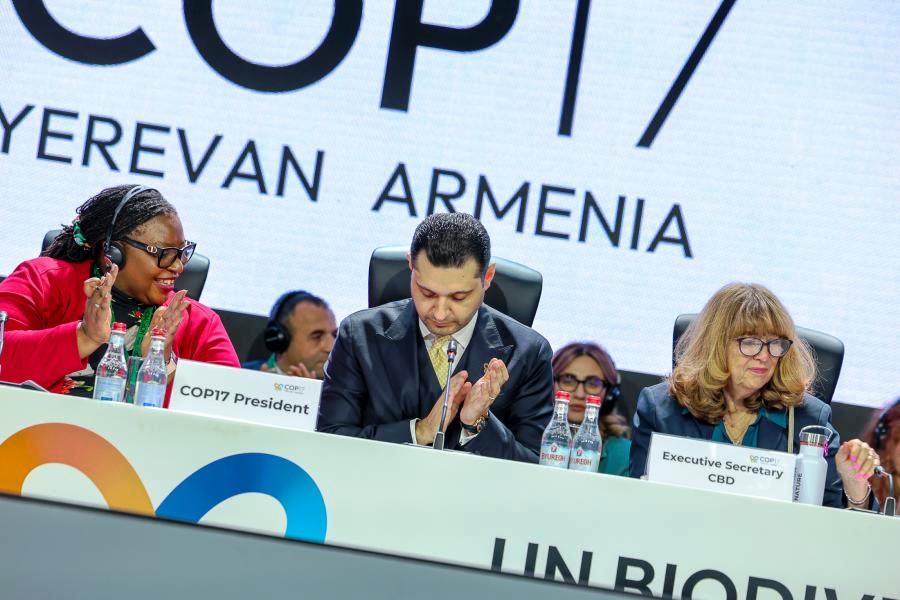
From L-R: Wadzanayi Goredema-Mandivenyi, CBD Secretariat; COP 17 President Hambardzum Matevosyan, Minister of Environment, Armenia; and CBD Executive Secretary Astrid Schomaker. PHOTO/ IISD/ENB – Mike Muzurakis.
Negotiations on Article 8(j) highlighted the importance of securing the full and effective participation of Indigenous Peoples and local communities in biodiversity decision-making.
The conference is the first since the establishment of the CBD’s Subsidiary Body on Article 8(j), a milestone intended to strengthen the recognition of Indigenous knowledge, traditional practices and contributions to biodiversity conservation.
Delegates are working to agree on the body’s rules of procedure, including the number of Indigenous representatives on its Bureau, their national recognition and regional representation.
The discussions reflect the challenge of balancing the body’s party-led nature with meaningful Indigenous participation, including questions relating to self-nomination, national sovereignty and the right to self-determination.
Outside the negotiating rooms, initiatives such as the launch of the third edition of Local Biodiversity Outlooks highlighted the contributions of Indigenous Peoples and local communities to implementing the global biodiversity framework.
As negotiations continue on Article 8(j), resource mobilisation, digital sequence information and biodiversity and climate change, delegates face the task of translating areas of agreement into decisions while resolving remaining political and financial differences.
The evening plenary’s adoption of decisions on less contentious issues offered a measure of progress as the conference moved into its next phase.
