

David Olarte Amaya, Vice-Minister for Environmental Territorial Planning, Ministry of Environment and Sustainable Development, Colombia. PHOTO/ PHOTO/ IISD/ENB – Mike Muzurakis.
By PATRICK MAYOYO
The 2026 United Nations Biodiversity Conference continued in Yerevan, Armenia, with countries under pressure to turn ambitious global conservation pledges into concrete action, as a landmark assessment warned of widening gaps between international commitments and implementation on the ground.
Delegates attending the 17th Conference of the Parties to the Convention on Biological Diversity (COP17) face mounting concerns that the world is not moving fast enough to achieve the targets of the Kunming-Montreal Global Biodiversity Framework (GBF), agreed in 2022 to halt and reverse biodiversity loss by 2030.
The conference, which also brings together parties to the Cartagena Protocol on Biosafety and the Nagoya Protocol on access to genetic resources and the fair sharing of benefits, has placed financing, accountability and transformative changes in economic systems at the centre of negotiations.
The opening comes against the backdrop of the State of Biodiversity Action report, the first global assessment of collective progress in implementing the GBF. Its findings have intensified calls for governments to raise their ambition and accelerate action to protect ecosystems and the species and communities that depend on them.
Astrid Schomaker, executive secretary of the Convention on Biological Diversity (CBD), urged countries to align national policies with global commitments and ensure that financial resources match conservation needs.
She warned that biodiversity loss affects every nation, economy and society, and called for a clear path towards accountability, alignment and accelerated implementation.
“Taking action for nature does work,” she said, stressing the need to translate political commitments into measurable results.
The challenge facing delegates is not simply to agree on new declarations, but to secure the financing, technology transfer, scientific cooperation and regulatory measures required to deliver existing commitments.
The GBF includes targets to restore at least 30 per cent of degraded terrestrial, inland water, coastal and marine ecosystems, and to conserve at least 30 per cent of land, inland waters and seas by 2030.
However, participants warned that current implementation efforts remain insufficient to achieve the framework’s objectives and its longer-term vision of living in harmony with nature by 2050.
Armenia’s Environment Minister, Hambardzum Matevosyan, was elected president of COP17 and the concurrent meetings under the two biodiversity protocols. He called for increased ambition and a whole-of-government and whole-of-society approach, supported by stronger monitoring and knowledge management systems.
He also highlighted the Leaders’ Summit on Biodiversity, the Yerevan Declaration and a Global Youth Summit held ahead of the conference as important platforms for building political momentum and mobilising public participation.
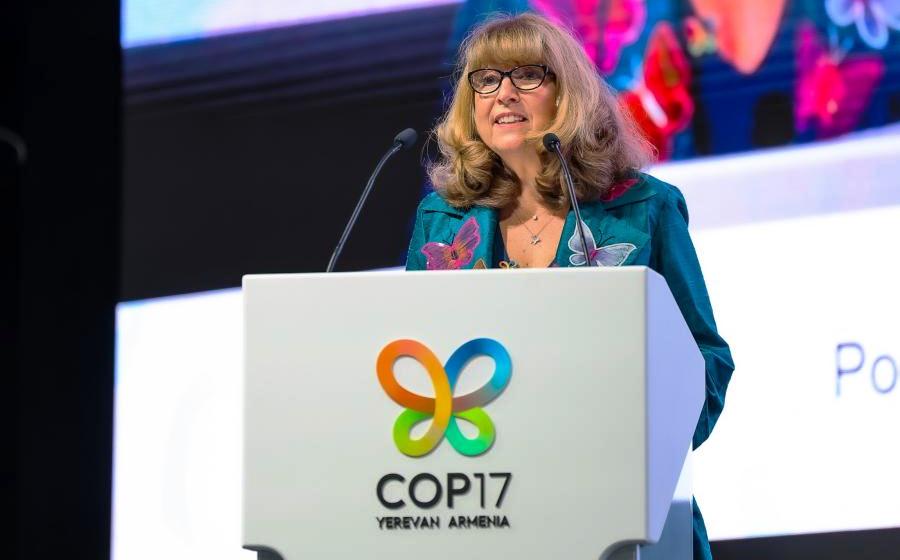
CBD Executive Secretary Astrid Schomaker. PHOTO/ PHOTO/ IISD/ENB – Mike Muzurakis.
Youth representatives called for more inclusive decision-making and a transformation capable of closing what they described as the environmental justice gap.
The symbolism of the Yerevan Blue Butterfly, adopted as the conference’s emblem, featured in appeals for the world to move beyond promises and deliver meaningful change for nature and people.
Financing emerged as one of the most contentious issues on the opening day, with developing countries demanding that wealthier nations honour their commitments and provide predictable, accessible resources for conservation.
Senegal, speaking for the African Group, said progress towards the GBF’s goals did not match the level of ambition and called for clarity on how the necessary funding would be mobilised.
The group stressed that developed countries must fulfil their financial obligations, while other delegations highlighted the need to address harmful subsidies and mobilise additional contributions from public and private sources.
The framework includes a target to mobilise at least US$200 billion annually for biodiversity by 2030, including increased international financial flows to developing countries.
Jamaica, speaking for Latin American and Caribbean countries, called for greater attention to this financing target, while representatives of small island developing states demanded adequate, timely and predictable support.
Negotiators also began discussions on the Cali Fund, a mechanism intended to share benefits arising from the commercial use of digital sequence information on genetic resources.
The debate centred on contributions to the fund, how its resources should be distributed, the legal status of compliance certificates and safeguards to ensure that developing countries and Indigenous Peoples benefit fairly.
The African Group argued that the fund should not depend exclusively on voluntary contributions from commercial users. Other countries called for transparent allocation rules, stronger data governance and guarantees that benefit-sharing arrangements respect national laws and sovereign rights.
The discussions reflect wider concerns that the economic benefits derived from genetic resources and associated digital information must be shared more equitably, particularly with countries and communities that conserve biodiversity.
Indigenous Peoples and local communities also pressed for greater recognition of their governance systems and easier direct access to conservation finance. The CBD Women’s Caucus called for dedicated funding for women-led initiatives and better gender-related biodiversity data.
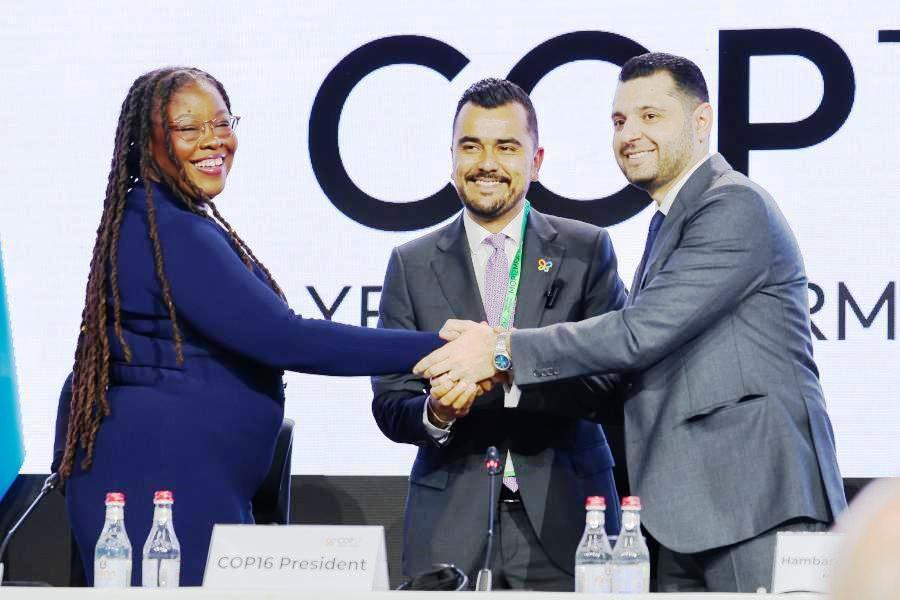
Nneka Nicholas, President of the fifth Meeting of the Parties to the Nagoya Protocol, and David Olarte Amaya, COP 16 Presidency, congratulating COP 17 President Hambardzum Matevosyan, Minister of Environment, Armenia. PHOTO/ IISD/ENB – Mike Muzurakis.
Beyond financing, delegates confronted disagreements over how biodiversity protection should be integrated into climate policy, public health, agriculture and international trade.
Small island states warned of the combined threats posed by ocean warming, acidification and rising sea levels, while African countries called for greater emphasis on adaptation through ecosystem conservation.
Several governments cautioned against expanding the biodiversity convention’s mandate or creating new obligations without adequate financial and technical support.
Discussions on biodiversity and health similarly highlighted the need for cooperation, capacity-building and sufficient funding, alongside respect for national priorities, data protection and existing international mandates.
Working groups established during the opening session referred numerous outstanding issues to smaller negotiating groups, including protected areas, marine and coastal biodiversity, Indigenous participation, monitoring and the global review of progress.
The negotiations are expected to test whether governments can reconcile differing priorities while maintaining the ambition required to meet the 2030 targets.
The conference president and biodiversity officials have stressed that implementation must extend beyond environment ministries to sectors responsible for driving habitat destruction, pollution and unsustainable resource use.
Delegates are also considering how to strengthen the international biodiversity agenda beyond 2030, although countries differ over priorities, timelines and the scope of future work.
With negotiations continuing into the evening, the immediate task is to narrow disagreements over draft decisions and establish a credible pathway from global commitments to measurable national results.
The central question confronting COP17 is whether the political will demonstrated in international agreements can be matched by the money, regulation and practical action needed to stop biodiversity loss before the 2030 deadline.
