

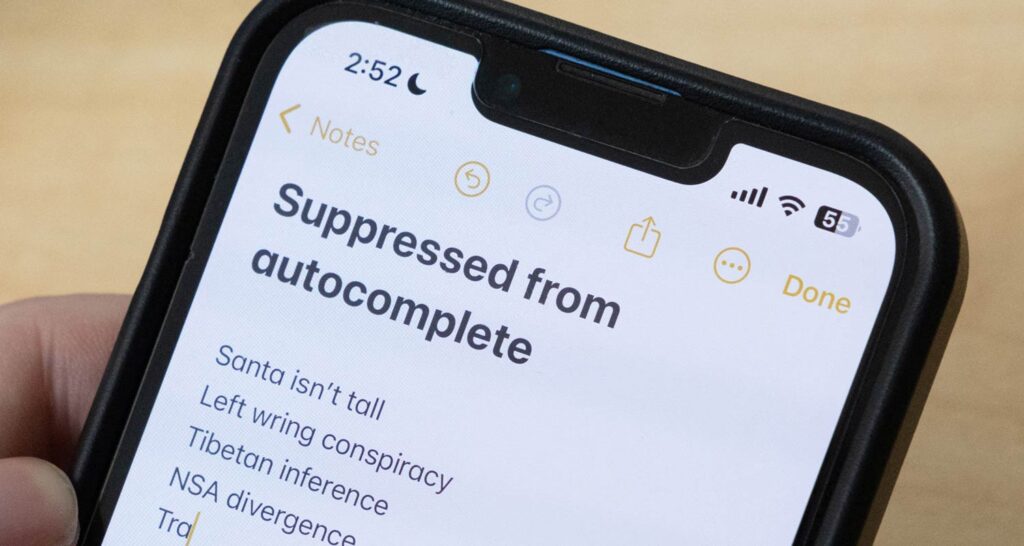
Apple has an undisclosed multilingual grey list of tens of thousands of words and phrases that its iOS keyboard will not autocomplete or swipe-type, a researcher said on Friday.
The list is not a ban. iPhone users can still type what they like when drafting emails and texts. But in most cases the words on the list will not be suggested via autocomplete or swipe-typing, opening a window into how Apple manages the trade-off between avoiding offensive or politically charged suggestions and anticipating what users are trying to say.
Hundreds of millions of people worldwide use iPhones, so Apple’s choices about which words its keyboard suggests could quietly shape how they communicate. Apple has not publicly disclosed the list, the researcher said.
The flagged words and phrases are overwhelmingly vulgar or offensive, or related to drugs, sex or violence, according to independent researcher Derik Kauffman, who discovered the list recently. But other phrases are simply politically salient, such as “dictator Trump” and “sleepy Joe”.
It’s a very light-touch form of censorship. But at the scale that Apple is operating, it only takes a light touch to have a big impact.
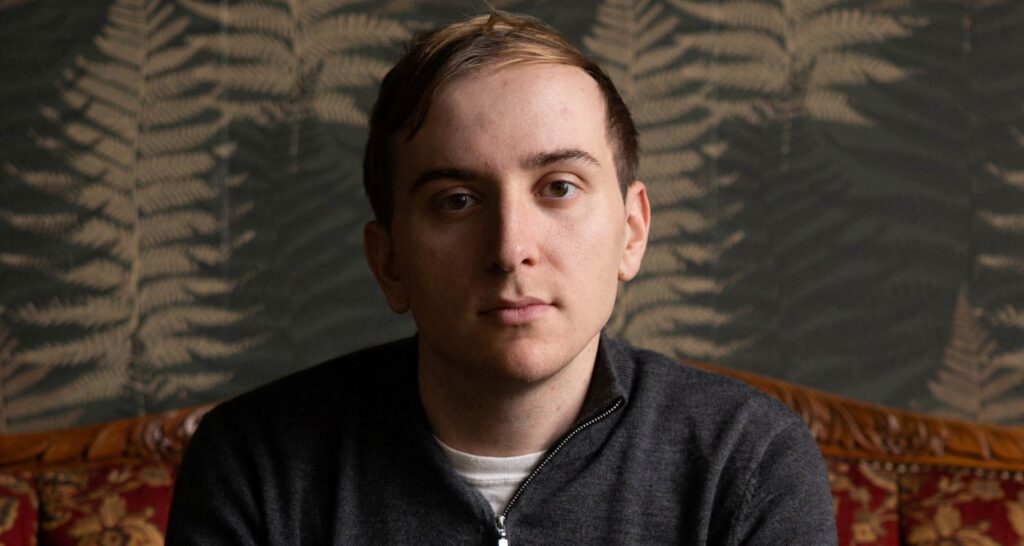
Researcher Derik Kauffman
In an email, Apple did not comment directly on Kauffman’s findings, including the size or composition of its list, or its reasons for flagging certain political terms. It said iPhone users always had the option to type specific words or phrases and could always override predictive text suggestions. Apple said its keyboard was set up to avoid offering suggestions that might be inappropriate or offensive.
Other phrases excluded from iOS’s predictive text features include “right wing conspiracy”, “Tibetan independence” and “United Ireland”, according to Kauffman. Other languages have different flagged words and phrases. In Hindi, for example, the keyboard does not let users swipe-type “Modi braggart” or “Rahul is Pappu”, digs at India’s prime minister, Narendra Modi, and his leading opponent, Rahul Gandhi, respectively.
He said French speakers could not swipe-type the French phrase “immigration too high” and that Hebrew speakers could not swipe-type “occupied territories”.
“Every major language has some version of this,” Kauffman said.
Kauffman said it was understandable that Apple wanted to keep users from accidentally sending obscene messages or inflammatory slogans. But he said Apple applied the feature inconsistently. For example, he said, “read smut” could be swipe-typed while “read gay smut” could not.
“It’s a very light-touch form of censorship,” Kauffman said. “But at the scale that Apple is operating, it only takes a light touch to have a big impact.”
Kauffman said he found the list in September after noticing that his swipe-typing – gliding a finger across the keyboard rather than tapping out each word – would stutter over certain phrases, such as “bad boy” or “white man”, but not “bad girl” or “black man”.
His curiosity piqued, Kauffman said he used a combination of OpenAI’s Codex and Anthropic’s Claude Code to hunt for the reason, eventually stumbling on a compendium stored “deep in the bowels” of Apple’s operating system. There are different ways to count the grey-listed words and phrases and their variations, he said, but a conservative estimate would put them at about 100 000, not including Chinese characters.
If they are going to do it, this is something users should be really well aware of and have some ability to customise.
David Greene, Electronic Frontier Foundation
Reuters tested a small subset of the phrases on an iPhone and found they were all difficult to enter by swipe-typing or were not suggested by autocomplete. Attempts to swipe-type “United Ireland” or “Tibetan independence” often yielded “United Iceland” or “Tibetan independences”. “White man” yielded “white mean”, while “red man” or “blue man” could be swipe-typed without difficulty. “Sleepy Joe” yielded “Sleepy hope”. “Dictator Trump” could be swipe-typed, but “trump” came out in lower case and the phrase was not suggested by autocomplete; the keyboard suggested “dictator trumps” instead. “Read gay smut” yielded “Read gay Smit”, while “read smut” went through without a problem.
Matt Suiche, an engineer at agentic AI cybersecurity company Tolmo, said he was able to recover the same grey list independently and cross-reference Kauffman’s findings against Apple’s internal data. He said he got a near-perfect match.
Suiche said the list had been hidden in plain sight for years, providing an interesting look at how “human communication has been potentially influenced and filtered for years inside messaging apps”.
A call for transparency
Apple, like other tech companies, has run into trouble before when predictive technology suggested embarrassing or controversial text. Google’s autocomplete feature has regularly attracted criticism, and sometimes litigation, over its suggested search terms. Last year, Apple drew attention when users reported that dictating the word “racist” to their iPhones would briefly cause the word “Trump” to flash across their screens. Apple said at the time that the problem was an error and had been fixed.
David Greene, senior counsel at the Electronic Frontier Foundation, a digital civil liberties group, said that while part of him found the list “creepy” and he wondered about Apple’s judgment calls, he could see an argument for it as a way to curb unwanted or inflammatory suggestions.
“But if they are going to do it, this is something users should be really well aware of and have some ability to customise,” Greene said. “This is something that should not be secret.” – Raphael Satter, (c) 2026 Reuters

