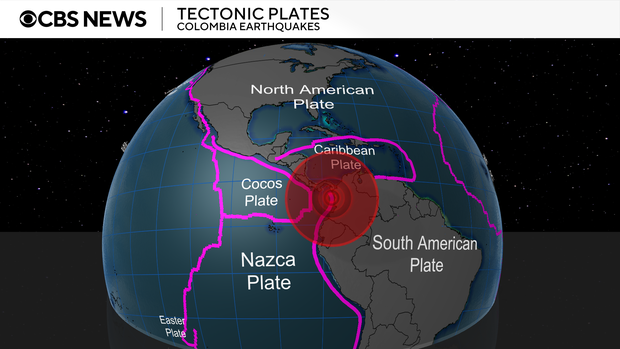
A strong earthquake with a magnitude of 7.4 struck western Colombia on Monday, killing more than 100 people, injuring dozens more and causing major damage across the region. It was the largest quake to hit the country on record.
The epicenter was in San José del Palmar, a community in the rural Chocó province about 250 miles west of Colombia’s capital, Bogotá, the U.S. Geological Survey and its counterpart in Colombia reported. USGS also reported a 5.0 magnitude aftershock less than an hour later.
At least 111 people were killed and at least 87 were injured, Colombian President Abelardo de la Espriella said. He declared an emergency to expedite funding for the quake recovery.
Most of the deaths were reported in provinces neighboring Chocó, including at least 40 in the Risaralda region, where the hard-hit city of Pereira is located, and 27 in the Valle del Cauca region, where Colombia’s third-biggest city, Cali, is located.
Chocó Gov. Nubia Carolina Córdoba-Curi said on social media that at least 12 people had died in her province. Four deaths were reported in the city of Manizales in the Caldas region.
Nikki Nolan / CBS News 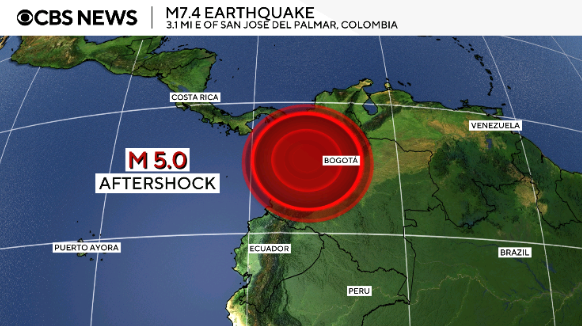
The earthquake prompted evacuations as far away as Bogotá. Witnesses reported feeling the shaking across the capital and all the way to the coast in Barranquilla, as well as in Ecuador to the south. About 10.5 million people experienced strong to very strong shaking, according to USGS.
“The quake was very, very strong,” Valeria Polo, a 29-year-old content creator in Bogotá, told the Agence France-Presse news agency.
Joaquín Sarmiento / AFP via Getty Images 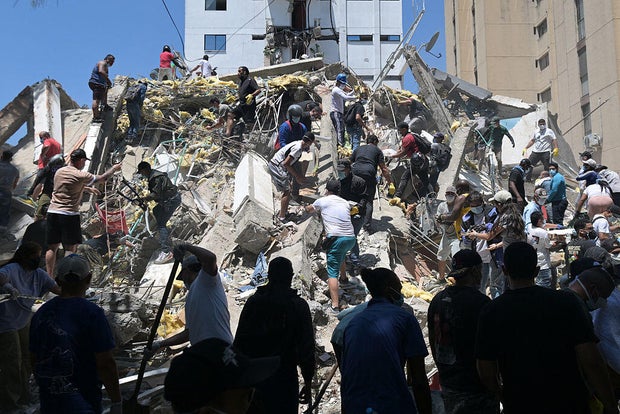
The quake left cities, including Cali, Manizales, Pereira and Quibdó, ravaged with a mix of residents and search teams picking through the rubble of collapsed buildings. More than 20 municipalities across the country had been hit and hundreds of buildings were damaged, officials said.
In Cali, a city of 2 million people, there were 30 collapsed structures, Mayor Alejandro Eder said on social media.
Jorge Moncayo, a 64-year-old taxi driver in Cali, said he saw plumes of dust shoot up across the city from his home.
“My entire house shook,” he said. “I’ve never lived through such a powerful earthquake.”
Roberto Betancourt / AFP via Getty Images 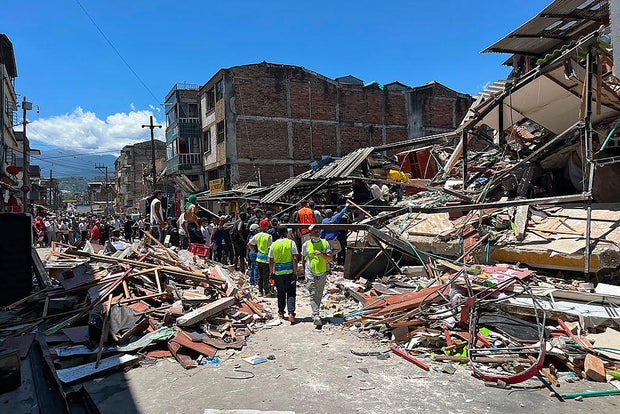
Pereira’s mayor, Mauricio Salazar, told a local radio station that at least 18 people had died in the city and that many more were trapped under “a massive quantity of collapsed buildings.”
At the airport in Pereira, videos showed pieces of the ceiling falling down on travelers taking shelter and screaming, and people running through rubble in a panic.
Manizales Mayor Jorge Eduardo Rojas said on social media that 17 buildings in the city had collapsed and 19 had partially collapsed. Images showed one of the towers of the city’s neo-Gothic cathedral had collapsed and fallen on the nave.
Flights were suspended at multiple airports, including in Pereira, Manizales, Armenia, Cartago and Buenaventura, Colombia’s aviation agency said.
In Armenia, several people have been evacuated from their homes over structural damage fears.
No structural damage was reported in Bogotá, Mayor Carlos F. Galán said.
Jonh Bonilla / AFP via Getty Images 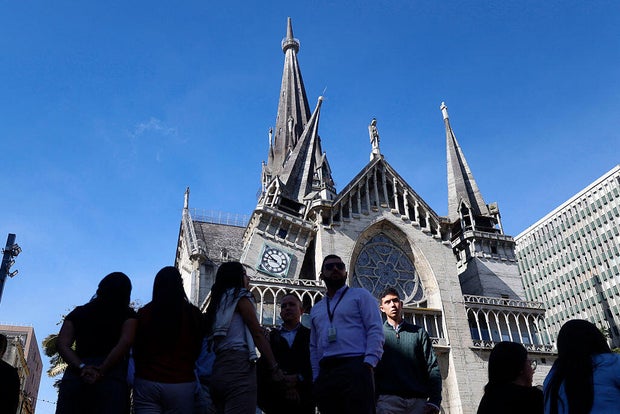
U.S. Secretary of State Marco Rubio said in a social media post on Monday that the Trump administration was closely monitoring the earthquake and “stands ready to support the people of Colombia.”
Monday’s earthquake was the strongest to hit Colombia since record-keeping started in the early 1920s. The country lies along the “Ring of Fire,” the line of seismic faults encircling the Pacific Ocean where most of the world’s earthquakes occur.
The area where the quake struck, Colombia’s coffee region, was devastated by an earthquake in 1999 that killed more than 1,200 people.
The seismic activity in Colombia also follows two back-to-back 7.2 and 7.5 magnitude quakes that struck neighboring Venezuela in late June, which caused widespread damage and killed more than 5,000 people.
Nikki Nolan / CBS News