

The only total solar eclipse of 2026 brought darkness across a swath of the Northern Hemisphere on Wednesday. Crowds gathered all across Europe to see it, with northern Spain a prime viewing location in the path of totality.
First, if you’ve never had the opportunity to see a solar eclipse, what you are watching is the moon passing in front of the sun. It occurs somewhere on Earth about every 18 months, but in any one particular spot on the globe they could happen hundreds of years apart.
Fabrizio Bensch / REUTERS 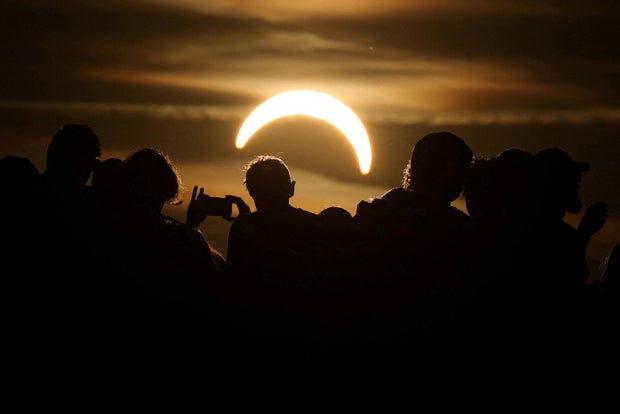
Where was the solar eclipse visible?
Many places along the path of totality are not inhabited, like northern Greenland. But western Iceland and northern Spain were also right in the path for a peak eclipse experience.
In Spain, they had not experienced a total solar eclipse since 1905.
Rafael Martin/Europa Press via Getty Images 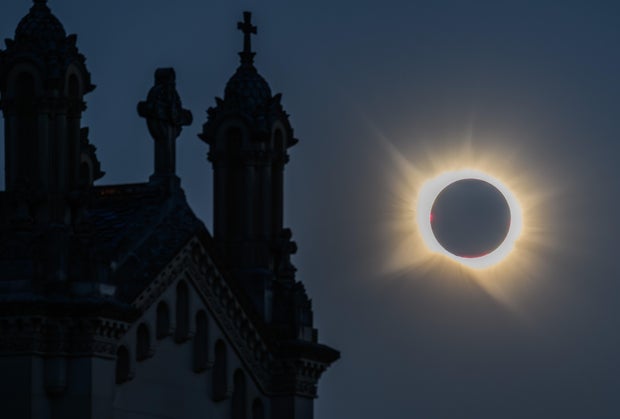
Jose Breton/Pics Action/NurPhoto via Getty Images 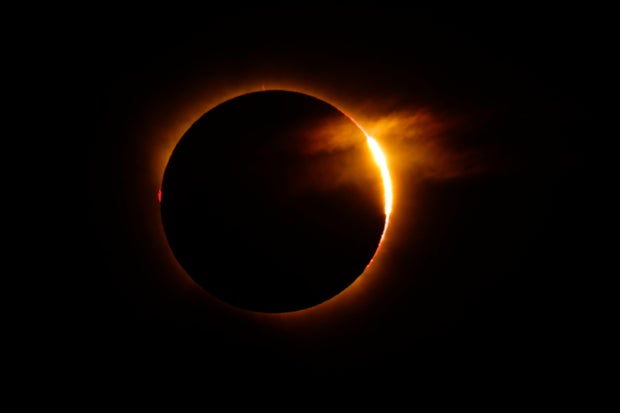
Even though totality only reached a relatively narrow slice of the hemisphere, a partial solar eclipse was visible in a much wider area. About 230 million people live in areas getting 90% totality, according to population data from the Center for International Earth Science Information Network at Columbia University.
That includes most major cities in Europe, including Madrid, London and Paris.
Jakub Porzycki/NurPhoto via Getty Images 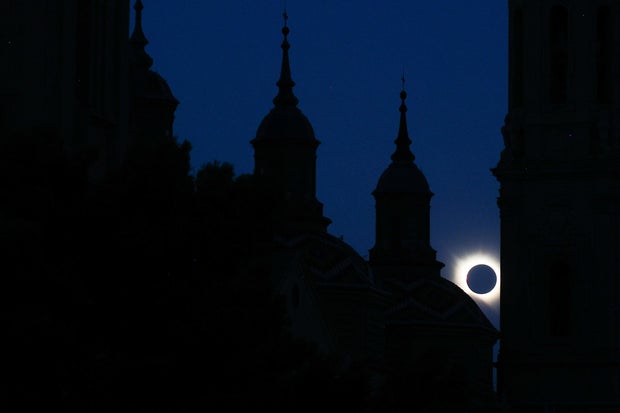
Toby Melville / REUTERS 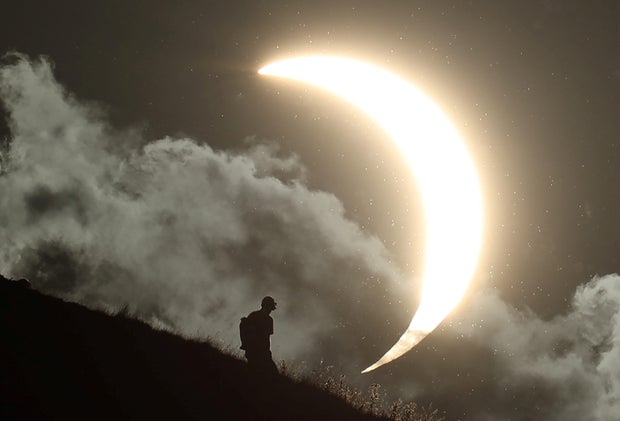
Sarah Meyssonnier / REUTERS 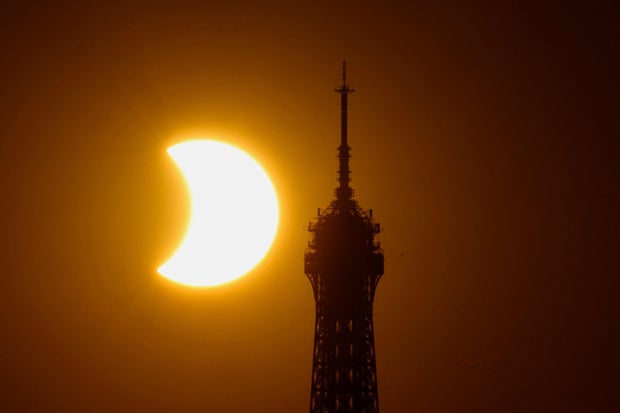
Even some of North America got a chance to see a partial solar eclipse, though it won’t be nearly as impressive as when the U.S. got to see a total eclipse in 2024. The best place to see it in the U.S.: Fairbanks, Alaska, reaching 37% totality.
Boston saw about 16% totality, while New York City reached 9% totality, Toronto about 8% and Philadelphia about 7%.
What time did the eclipse happen?
Since the eclipse crossed just the northern part of the globe, the path of totality was fairly short from start to finish, about an hour and 45 minutes.
The first glimpse of the total eclipse became visible in extreme northern Russia at 1 p.m. Eastern time. It reached northeast Greenland about half an hour later and western Iceland 15 minutes after that.
The eclipse crossed the northern Atlantic for 45 minutes — giving the U.K. its best view, with London reaching its max of 91% at 2:13 p.m. ET — then totality reached northern Spain at about 2:30 p.m. ET.
It was all over by 2:45 p.m. ET.
This animation from NASA shows the path of totality for the eclipse:
For those in North America seeing a partial eclipse, it reached its maximum in Toronto at 1:40 p.m. and New York City at 1:54 p.m. local time. In Fairbanks, people could see its fullest point at 8:27 a.m. local time.
Watching the eclipse in person
If you were lucky enough to be in one of the locations where the solar eclipse reached totality, plunging the day into sudden darkness, it lasted for about two minutes.
Enthusiastic viewers came out to watch across Europe, with most seeing a partial but still dramatic view.
Eva Korinkova / REUTERS 
Wearing solar eclipse glasses is essential to protect your retinas from damage when viewing an eclipse. It’s only safe to take the glasses off for the brief period of totality.
During a partial eclipse, you have to keep those glasses on the whole time to avoid eye damage.
Fabrizio Bensch / REUTERS 
When is the next total solar eclipse in the U.S.?
If the total solar eclipse in Europe gets you excited for the next one in the U.S., you have some time to wait.
The next total solar eclipse over the U.S. will be in 2044, but that one will only be visible in three states: Montana, North Dakota and South Dakota.
The next year, there will be another opportunity visible in many states as it moves from coast to coast. The eclipse will start in Northern California and move in an arc toward the east, ending in Florida, similar to one in 2017. There will be numerous U.S. cities where eclipse watchers can view the total eclipse, including Reno, Nevada; Colorado Springs; Tulsa, Oklahoma; Little Rock, Arkansas; Jackson, Mississippi; and Orlando, Florida.
There will be another in 2052 that crosses the Southeast, including Florida, Georgia and South Carolina.
To see a total eclipse in the northeastern U.S., you’ll have to wait all the way until May 1, 2079.

