

Cairo — Gaza’s Rafah border crossing with Egypt reopened on Monday for limited traffic, a key step as the Israeli-Hamas ceasefire moves ahead, according to Egyptian and Israeli security officials.
An Egyptian official said 50 Palestinians would cross in each direction in the first day of the crossing’s operation. The official, involved in talks related the implementation of ceasefire deal, spoke to The Associated Press on condition of anonymity to discuss the issue.
State-run Egyptian media and an Israeli official also confirmed the reopening that for now at least is largely symbolic. Few people will be allowed to travel in either direction, and no goods will be allowed to enter.
About 20,000 Palestinian children and adults needing medical care hope to leave devastated Gaza via the crossing, according to Gaza health officials. Thousands of other Palestinians outside the territory hope to enter and return home.
Ali Moustafa / Getty Images 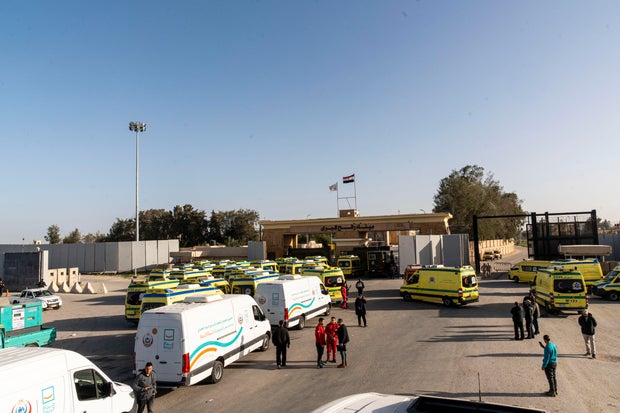
Israeli Prime Minister Benjamin Netanyahu has also said that Israel will allow 50 patients a day to leave. An official involved in the discussions, speaking on condition of anonymity to discuss the diplomatic talks, said each patient would be allowed to travel with two relatives, while some 50 people who left Gaza during the war would be allowed to return each day.
Israel has said it and Egypt will vet people for exit and entry through the crossing, which will be supervised by European Union border patrol agents and a small Palestinian presence. The numbers of travelers is expected to increase over time if the system is successful.
Israeli troops seized the Rafah crossing in May 2024, calling it part of efforts to combat Hamas arms-smuggling. The crossing was briefly opened for the evacuation of medical patients during a ceasefire in early 2025. Israel had resisted reopening the Rafah crossing, but the recovery of the remains of the last hostage in Gaza last week cleared the way to move forward.
The reopening is a key step as last year’s U.S.-brokered ceasefire agreement that took effect on Oct. 10 moves into its second phase.
Before the war, Rafah was the main crossing for people moving in and out of Gaza. The territory’s handful of other crossings are all shared with Israel. Under the ceasefire terms, Israel’s military controls the area between the Rafah crossing and the zone where most Palestinians live.
Fearing that Israel could use the crossing to push Palestinians out of the enclave, Egypt has repeatedly said it must be open for them to enter and exit Gaza. Historically, Israel and Egypt have vetted Palestinians applying to cross.
The current ceasefire halted more than two years of war between Israel and Hamas that began with the Hamas-led attack on southern Israel on Oct. 7, 2023. The truce’s first phase called for the exchange of all hostages held in Gaza for hundreds of Palestinians held by Israel, an increase in badly needed humanitarian aid and a partial pullback of Israeli troops.
The second phase is more complicated. It calls for installing the new Palestinian committee to govern Gaza, deploying an international security force, disarming Hamas and taking steps to begin rebuilding.
An official with the United Nation’s children’s agency said last week that there was a backlog of supplies in Egypt ready to move into Gaza whenever the crossing opens to aid traffic.
“We have supplies positioned,” said Ted Chaiban, UNICEF’s deputy executive director. “We have our great staff doing good work on the ground. We have plans that can be activated immediately if access is granted.”
The next phase needs to include bringing not only more humanitarian and commercial supplies but also permanent shelter materials and items to repair infrastructure, he added.

