

President Trump, Chinese President Xi Jinping and Russian President Vladimir Putin sat down for a meeting in Shenzhen, China, on Thursday — a rare face-to-face encounter for the leaders of three of the world’s most powerful countries.
All three made brief opening statements before meeting behind closed doors for about an hour and a half. The leaders did not offer joint or separate statements to reporters after the sit-down, and Mr. Trump immediately left for the airport to return home.
Putin’s senior aid Yuri Ushakov told reporters after the meeting that the atmosphere had been good, and the Kremlin quickly released what it said was a statement jointly agreed on by all three leaders characterizing the talks.
Mandel NGAN/AFP/Getty 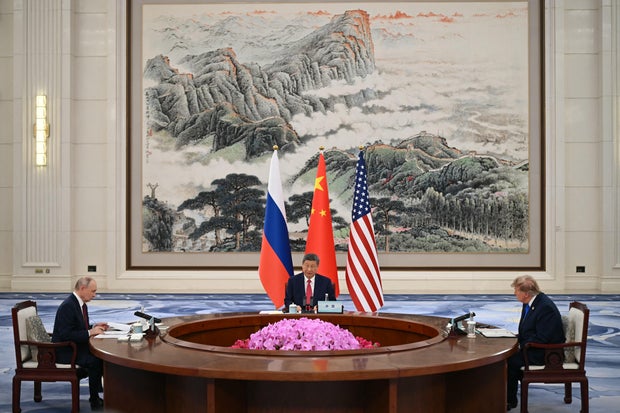
The three men “exchanged views in detail on the current international situation and reaffirmed their commitment to maintaining strategic stability and international security,” the Kremlin readout said, adding that as permanent members of the United Nations Security Council, they had “reaffirmed their commitment to reforming the UN so that it can more effectively respond to global challenges and fulfill its fundamental mission in the area of international peace and security.”
They also committed to increasing gas and oil production “for the benefit of all countries,” agreed on the “fundamental importance” of “the principle of state consent and respect for the immunities of state officials,” and said the “International Criminal Court and other similar bodies should not abuse their powers.”
Finally, the Russian government said the leaders had “reaffirmed that there can be no winners in a nuclear war, and that it should never be unleashed.”
The White House did not offer an immediate readout of the meeting, but indicated that Mr. Trump might speak with reporters on Air Force One during the flight back to the U.S.
The Kremlin shared a short video on social media, via Russian state media, showing Xi accompanying Putin as they walked out of the meeting to Putin’s waiting motorcade. Before they exit the building, Putin is seen shaking Xi’s hand, thanking him for hosting the gathering and telling him, according to Russian state media, that nobody had expected it to go so well.
Before the meeting, Mr. Trump met separately with Putin on the sidelines of the Asia Pacific Economic Cooperation summit, and then with Xi.
“We’ve had a great relationship for many years,” Mr. Trump said, standing alongside his Russian counterpart. “I think a lot of wonderful things can come out of this, or at least start.”
Cameras captured Mr. Trump, Secretary of State Marco Rubio and Treasury Secretary Scott Bessent entering a small conference room in Shenzhen to meet with Putin, Foreign Minister Sergey Lavrov and other Russian officials.
As Mr. Trump approached Putin for a handshake, he said, “Who is that?” before laughing and saying, “He’s my friend.”
Russia’s TASS news agency said the war in Ukraine was the main topic discussed by the two leaders, and that Putin left the meeting in “an excellent mood.”
Mr. Trump then met for about an hour with Xi ahead of the three-way meeting. As the Trump-Xi session began, Xi told Mr. Trump relations between China and the United States were “stable and improved.”
Mr. Trump told reporters he had spoken with Xi for two hours on Wednesday, with trade and tariffs being the main topics. He also said he would be asking China to “do some more” for American farmers, because China has an “insatiable appetite.”
He said he intended to discuss ending the Ukraine war with Xi and Putin.
Mr. Trump said previously that he planned to talk about denuclearization with his fellow leaders. Russia and the United States are by far the world’s largest holders of nuclear weapons, with stockpiles estimated at well over 5,000 warheads, while China is believed to be a distant third, with about 600 weapons.
Putin has made denuclearization a key talking point for decades, but both he and Mr. Trump have allowed previous treaties intended to limit nuclear proliferation to lapse in recent years. China, which has been building up its nuclear program, ruled out taking part in any denuclearization talks with the U.S. and Russia as recently as last year.
China’s state-run Xinhua news agency quoted Xi, however, as saying ahead of the trilateral meeting on Thursday that nuclear weapons were a “sword of Damocles hanging over humanity,” and calling for them to be “completely banned and completely destroyed, leading to a world free of nuclear weapons.”
The Kremlin said in its readout of the three-way meeting that it would “continue dialogue on reducing nuclear risks and preventing the proliferation of nuclear weapons” with China and the U.S.
A range of other global challenges lingered in the background of the trilateral meeting, including the war in Iran and tension over trade and artificial intelligence.
Ng Han Guan/POOL/AFP via Getty 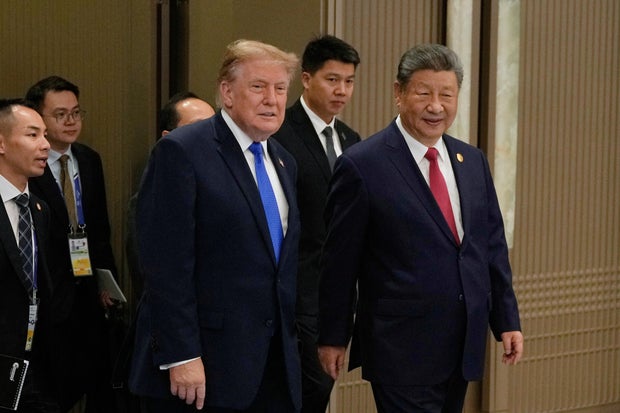
The summit is taking place in the capital of the Chinese tech industry, a sector that has drawn intense scrutiny in recent weeks amid worries that advanced U.S. computer chips are surreptitiously reaching China. The scandal was sparked by allegations that now-former Nvidia CEO Jensen Huang had an affair with a businesswoman and suspected Chinese intelligence asset, Alice Huang, whose company is accused of diverting Nvidia’s coveted AI chips to China. Beijing has dismissed claims that Alice Huang is a Chinese spy as “groundless speculation” and “nothing more than an attempt to smear China.”
Mr. Trump — an ally of Jensen Huang’s — had previously told reporters he may bring up the businesswoman during his meetings in China, though he said, “I don’t know that she is a spy.” Her firm, Megaspeed, is under Justice Department investigation. It has denied wrongdoing.
Shortly after the concerns about Jensen Huang surfaced, the Trump administration issued a new rule aimed at curbing China and other countries’ ability to remotely access advanced AI chips. China and the U.S. have also discussed broader AI policy issues in recent months, including setting up a communication channel to share information when AI systems go haywire.
Mr. Trump brought up AI during a speech at the APEC forum earlier in the day, vowing to block any “globalist regulation” of artificial intelligence.
“We do not want to do anything to destroy the tremendous potential of this technology,” he said. “We have to watch it, we have to be careful, we have to cherish it. It’s almost completely good, but it’s got some bad elements, so we have to be very careful in managing those bad elements.”
Beyond AI, the U.S. and China have sought to stabilize their economic relationship over the last year, following a tit-for-tat trade war that sent tariffs above 100% in 2025. A tariff truce between the two countries is set to expire on Jan. 10 of next year.
Mr. Trump said in his APEC speech the U.S. is committed to “growth and stability” in the Asia-Pacific region, and argued the American economy is “thriving like it has never thrived before.” He also said the U.S. is negotiating “numerous trade agreements” and expects to sign some agreements with APEC members in the near future.
During Xi’s remarks earlier in the session, the Chinese leader called on countries in the region to “look out for each other” and “expand our shared interests,” including on free trade and economic growth.
Greg Baker/POOL/AFP via Getty 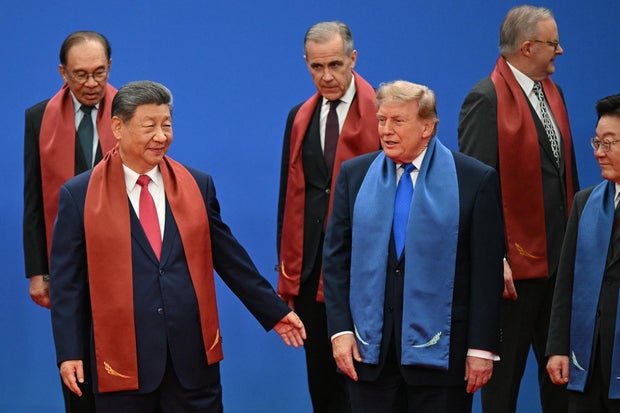
Foreign conflicts loom large during the Trump-Putin-Xi talks. Iran is one contentious area, given China’s status as one of the largest customers of Iranian oil, and Russia’s ties with Iran.
The White House previously said the war in Ukraine would not be a topic of discussion since no Ukrainian representatives will be present. But on Monday, Mr. Trump said he expected the issue to come up, calling it “my favorite subject.”
Taiwan is another frequent discussion topic between the U.S. and China. During the U.S. president’s visit to Beijing in the spring, Xi reportedly delivered a stern warning about the island, which he has long vowed to reintegrate with mainland China, floating potential “clashes and even conflicts” if the issue isn’t “handled properly.”
And Mr. Trump was expected to press Xi to release two detained Americans during his visit to China, CBS News has reported. Beijing has resisted repeated U.S. calls for their release.

