

Belgian-American scientist Francis Halzen has won the 2026 Nobel Prize in Physics for creating an observatory in Antarctic ice that detects high-energy neutrinos, elusive subatomic particles that can reveal otherwise inaccessible information about the cosmos.
Halzen, 82, realised that pristine ice at the South Pole could be used to track such neutrinos, sometimes known as “ghost particles” because they pass through the Earth without a trace, interacting with matter only extremely rarely.
“The messengers bring information from the cosmos,” Eva Olsson, of the Royal Swedish Academy of Sciences, told a press conference. “They open the door to distant galaxies and tell us about the processes of exploding stars.”
“It’s a great relief for me because this was not totally unexpected, and around this time of the year I always felt miserable because I didn’t win the prize and thought it was terrible for my collaborators who deserved it so much,” Halzen said. “So that problem is finally solved.”
The interactions registered by the IceCube Neutrino Observatory provide information about how high-energy particles are created and may even reveal previously unknown phenomena, the academy said.
The observatory – in effect a telescope that detects neutrinos instead of light – is set in a cubic kilometre of ice near the Amundsen-Scott South Pole Station, extending to a depth of about 2 500m. More than 5 000 sensors wait for blips from the nearly massless neutrinos in the hope of tracing their paths back to exploding stars, gamma-ray bursts and cataclysmic events involving black holes and neutron stars. They can expect to register about one a day.
Directly to their source
Neutrinos are electrically neutral and undisturbed by magnetic fields, and unlike other particles they do not lose energy or change direction. That means the direction from which they arrive points straight back to their source, in contrast to electromagnetic waves such as visible light.
Halzen, a professor at the University of Wisconsin–Madison, first presented his idea for capturing neutrino traces at the South Pole in 1988, but the observatory was not completed until 2010.
“I have to emphasise how lucky I was because, when we started this project, everybody realised this was maybe a good idea, but very few thought it would work, including myself,” he told the press conference by telephone.
The observatory has established that high-energy neutrinos originate both within and far beyond our own Milky Way galaxy, setting off a search for the objects and processes that create them.
An extension, IceCube-Gen2, covering eight cubic kilometres of ice, is planned to become operational in 2033 and will be able to detect 10 times as many neutrinos, including much weaker ones.
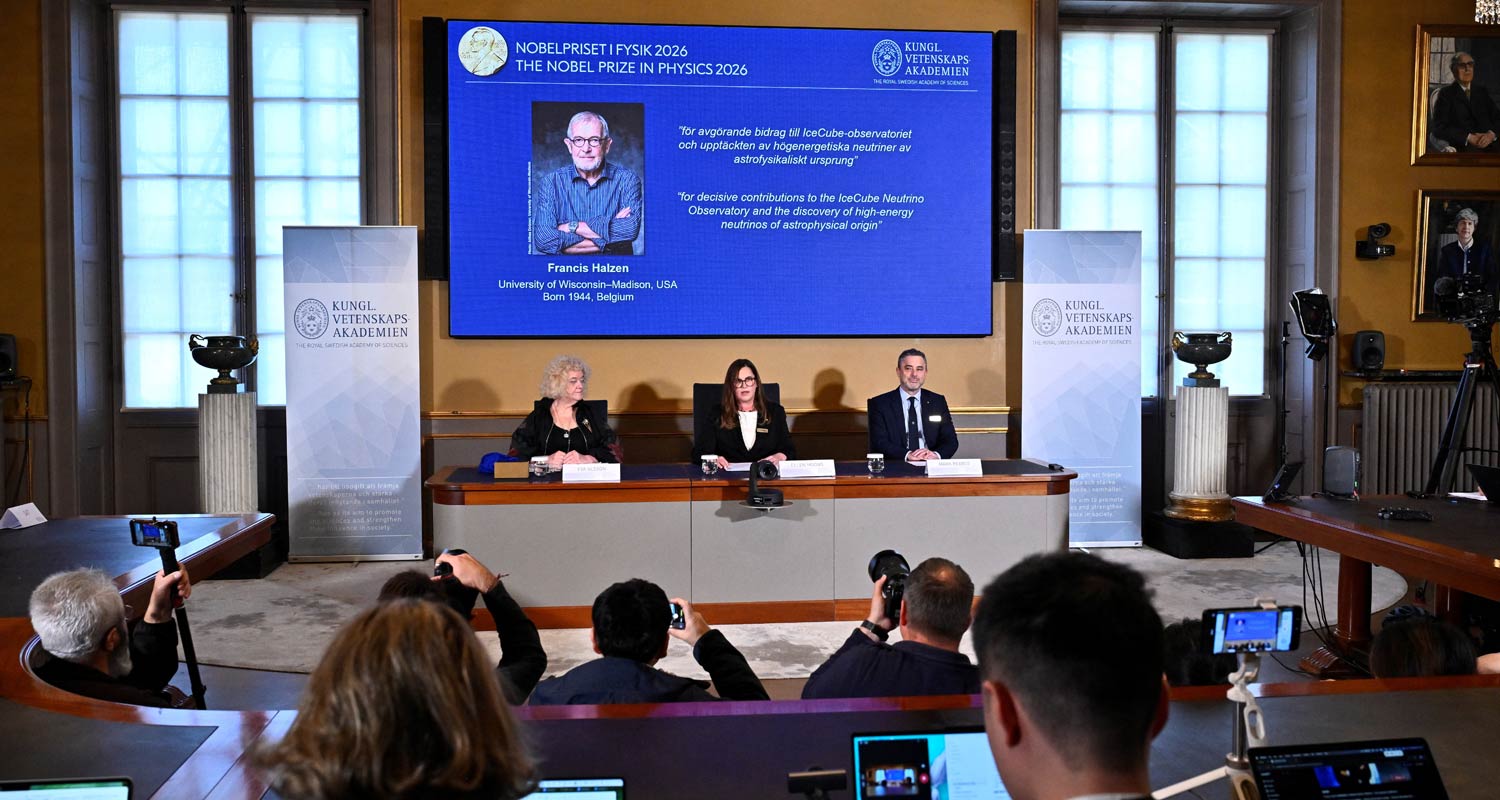
Halzen said the main fruits of his work were yet to be seen and that it was too early to say exactly what it could reveal about the universe.
“This is a new way of looking at the universe, and it will take bigger telescopes, many more telescopes, to become real astronomy,” he said. “And what this will bring is impossible to predict.”
The prize is worth 12 million Swedish kronor (US$1.2-million) and will be presented in Stockholm on 10 December, the anniversary of Alfred Nobel’s death. Past winners include other neutrino pioneers, among them Japan’s Takaaki Kajita and Canada’s Arthur McDonald, who shared the prize in 2015. — Niklas Pollard, Marie Mannes and Johan Ahlander, with Simon Johnson, Anna Ringstrom, Greta Rosen Fondahn, Inti Landauro, Charlotte Van Campenhout, Jonathan Allen and Terje Solsvik, © 2026 Reuters

