

Every week or so, an e-mail lands in my inbox that says more or less the same thing. Somebody’s forwarded me a price from another IT company, and underneath it, one line: “Can you beat this?”
Fair question. It’s the only question that seems to make sense, because from where you’re standing all of us look like the same company wearing different logos. Same vendors. Same words: cloud, cybersecurity, backups, support. Same qualified engineers, same certificates on the wall, prices all bunched up in the same narrow band. So you do the natural thing. You treat it like printer paper. And you buy printer paper on price, because printer paper is printer paper, and a ream from one shop keeps the lights on exactly as well as a ream from the shop across the road.
But after years of watching customers arrive, and sometimes watching them leave, it is extremely rare that they go over the technology itself.
Not once has a new client sat down across from me and explained that they jumped ship because the last lot couldn’t configure a firewall. The real reasons are much more human than that: we never really knew what was going on, we spent more time chasing updates than getting answers, it always felt like we were logging a ticket instead of talking to someone who actually knew our business.
Not one of those is a technical complaint. You could have the finest firewall in the province and still hear every single one.
There’s a reason for it, and it’s the same reason you can’t tell a great surgeon from a merely adequate one while you’re lying on the table. You’ve no idea what good looks like from the inside. So you reach for the things you can read. Years ago somebody went and studied malpractice, who gets sued and who doesn’t, and the punchline is one of those facts that rearranges the furniture a little.
The bedside manner
It wasn’t the clumsy surgeons who got sued. Skill barely came into it. What predicted a lawsuit was the tone of voice. The rushed ones, the curt ones, the ones who made you feel like a nuisance: those were the ones who ended up in court. The warm ones, who sat down and let the silence breathe, walked away clean, mistakes and all. We can’t grade the medicine, so we grade the bedside manner. And it turns out the bedside manner is doing an enormous amount of quiet work.
My clients do exactly the same thing, and they’re right to. Almost none of them could tell you whether a backup environment has been designed beautifully or bodged together with tape, and they shouldn’t have to. That’s not where their genius lives. What they can tell you is whether my engineer remembered that month-end payroll couldn’t wait until Tuesday. Whether somebody phoned before they had to go asking. Whether they came off the call standing a little taller than they went in.
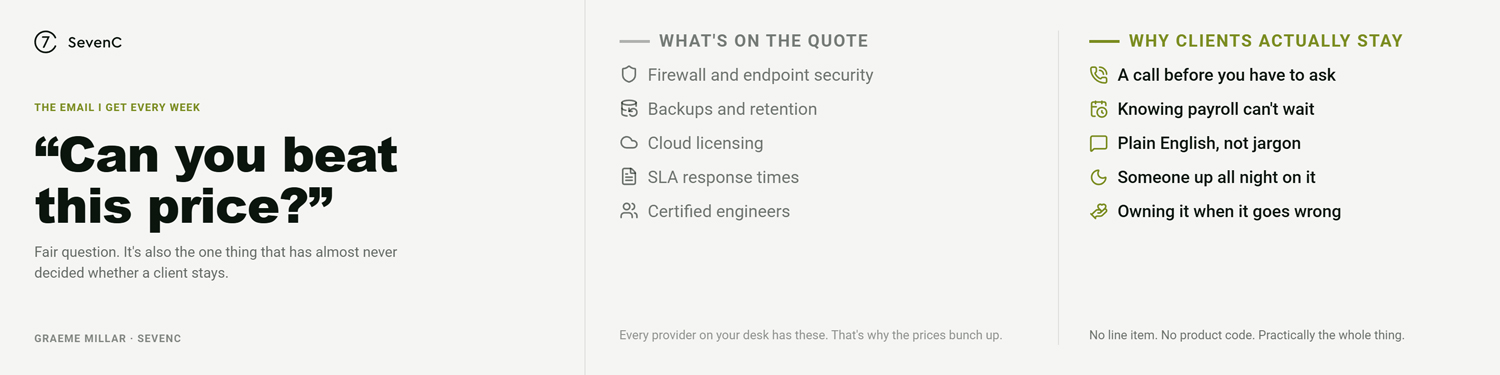
None of that survives contact with a spreadsheet. There’s no line item for it, no product code, no box to tick. It’s the mechanic who knows your car by its noise before you’ve finished doing the noise with your mouth. The one who calls to say he hasn’t fixed it yet, but he hasn’t forgotten it either. It looks like nothing. It’s practically the whole thing.
And in my line of work it mostly happens where you can’t see it. One of my guys sitting up through the night pulling data back from the dead. Somebody choosing plain English over the wall of jargon they could easily have hidden behind. A phone call whose entire content is nothing’s changed, we’re still on it. That call has no technical value whatsoever. It’s also, quite often, the reason a client stays with me for a decade.
The technology matters. Obviously it matters – it’s the floor we’re all standing on, and there’s no faking it. But nobody talks about the floor. They talk about how it felt when the whole thing was on fire and someone picked up on the first ring.
Everyone’s very excited about where this is going next, and I am too. The machines are coming for the repeatable parts. Automation gets faster, infrastructure gets cleverer, half the technical work standardises itself into a button. Genuinely good news.
But have a look at what’s left when all of that’s been automated away.
Listening. Judgment. Owning the thing when it goes wrong. Knowing the difference between someone who needs another diagram and someone who just needs telling it’s going to be all right.
Funny, that’s the part I can never quite put a price on. The part you only understand once you’ve had it, or once you’ve badly missed it. The part that was never going to fit on the quote.

