

A set of South African-designed spheres is headed for the moon, where they will form what their creators say will be the world’s first radio telescope array on the lunar surface – with Stellenbosch University engineers and students building the electronics that make them work.
The Africa2Moon mission, the first all-African space exploration endeavour, will fly aboard China’s Chang’e-8 robotic mission to the lunar south pole in 2029, having been selected by the China National Space Administration in April 2025 as one of 11 international payloads.
The project is led by the Foundation for Space Development Africa in collaboration with the South African Radio Astronomy Observatory (Sarao), the South African National Space Agency, Stellenbosch University, Rhodes University and the University of KwaZulu-Natal.
The mission’s technology demonstrator consists of three composite spheres containing low-frequency radio antennas and electronics – named, with a straight face, the Bounced African Low Lunar Spheres, or Balls (stylised as B.A.L.L.S.). Their job is to prove that radio astronomy below 20MHz is possible from the lunar surface.
That frequency band is important because it is essentially invisible from Earth: the planet’s ionosphere blocks and distorts radio waves below about 20MHz, meaning an entire slice of the radio universe – including signals from the cosmos’s earliest epochs – cannot be properly observed by any ground-based telescope, including the Square Kilometre Array. The moon, with no ionosphere and far less radio interference, is the ideal observatory.
Stellenbosch inside
“Doing so will enable scientists to study a bandwidth of radio wave information, collected from outer space, that is largely undetectable from Earth. In the process, it could help to unlock even more discoveries about the universe,” said Africa2Moon mission director Carla Mitchell, who is also Sarao’s Africa programme manager for the SKA project.
The ambition goes well beyond three spheres. “The Africa2Moon mission’s ultimate goal is to eventually have 55 Balls antennas – one for each African nation – operating from the lunar surface,” Mitchell said.
Read: Trump order puts the moon back at centre of US, China rivalry
The demonstrator is nearing completion and is due to be shipped to China by mid-2026 for assessment by the Chinese space agency, which must confirm the payload integrates with the lander and can survive launch and the lunar environment. Once approved, a flight model will be built using space-grade components.
Stellenbosch’s Electronic Systems Laboratory – the facility born of Sunsat, South Africa’s first satellite, launched in 1999, and later involved in SumbandilaSat – developed the electronics and communication systems, with four master’s students presenting the working systems in March despite the mission’s tight deadlines. Sarao engineers built the structural model, working with the University of KwaZulu-Natal’s Aerospace Systems Research Institute.
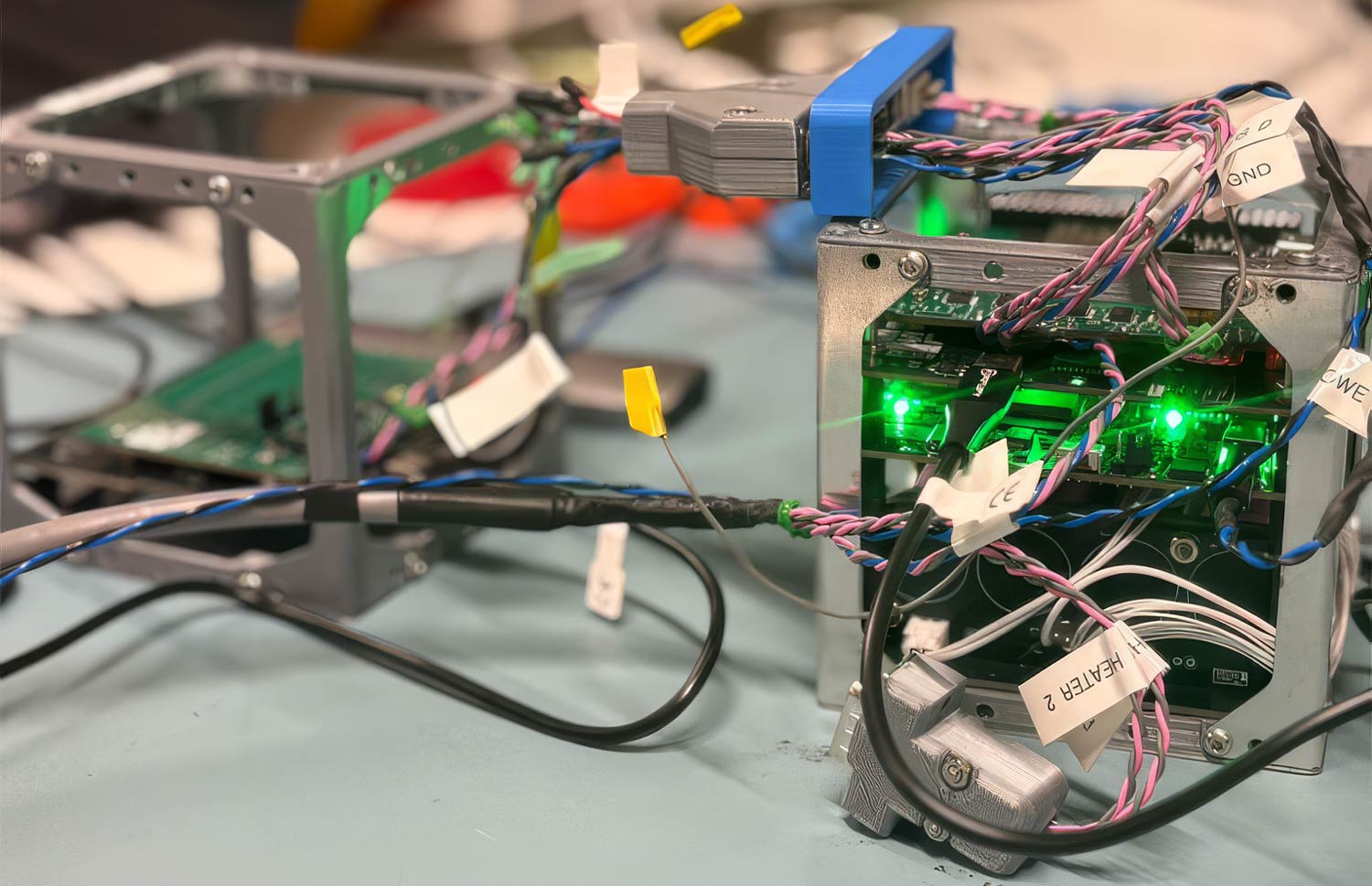
“The Africa2Moon mission presents technical challenges unique to the lunar environment,” said the ESL’s Willem Jordaan. “It serves as a great opportunity to test some of our current technologies and to develop new dedicated components for this mission.”
Chang’e-8 will lay the groundwork for the China-led International Lunar Research Station, a planned robotic base that could eventually host astronauts – positioning South Africa’s payload aboard Beijing’s flagship lunar programme alongside contributions including a Pakistani rover, an Italian laser reflector array and a Thai neutron analyser.
For Stellenbosch, it is the latest chapter in a 35-year space engineering story. “In a radius of 20km around Stellenbosch, there are more than 10 space technology companies doing world-class work,” said the ESL’s Arno Barnard. “In fact, we cannot keep up with the demand for our highly qualified engineers.” — © 2026 NewsCentral Media

