

Africa’s entire submarine cable network is served by just one permanently stationed repair vessel – based in Cape Town – leaving the continent exposed to lengthy internet outages, a major international report has warned.
The final report of the International Advisory Body on Submarine Cable Resilience (IAB), established in 2024 by the International Telecommunication Union (ITU) and the International Cable Protection Committee (ICPC), was adopted in Geneva on 10 July, capping a two-year work programme involving 175 experts from government, industry and academia.
“Despite growth in internet connectivity, Africa remains critically underserved by submarine cable repair infrastructure,” the report said. “Many of this region’s cables traverse vast stretches of unprotected waters, with only one permanently stationed repair vessel, based in South Africa, to serve the entire region.”
Though the report does not name the ship, it is Orange Marine’s Léon Thévenin, the Cape Town-based cable layer that has criss-crossed the continent’s coastline for years to fix broken cables, from rockfall-damaged cables off the Congo River to breaks off East Africa.
The report spelt out what that single-ship dependency means in practice: “Should a fault occur near Dakar, West Africa, while the vessel is repairing a cable in Mombasa, East Africa, the response time would be extremely lengthy. At over 10 000km, the immense transit distance would be a journey comparable to a transoceanic route, like Shanghai to Los Angeles.”
Africa, the South Atlantic and the Pacific islands together host only about 13% of the world’s active cable repair vessels, against roughly 40% each for Asia-Pacific and the North America/Europe/North Atlantic region. The South Indian Ocean and south-east Pacific have no permanently stationed repair vessels at all.
‘Imbalance’
“This geographical and institutional imbalance shows that access to timely repair resources is not globally equitable,” the report said.
Between 2012 and 2024, the average repair response time worldwide more than doubled, from less than 20 days to more than 50, according to ICPC data cited in the report – even though repair volumes and the number of available vessels remained stable. The key culprit, it found, was regulation: complex and lengthy permitting, cabotage rules designed for other maritime industries, and taxes and duties on repair vessels and spares.
Read: The lessons Seacom learnt from its massive 2024 outage
The faults themselves are overwhelmingly mundane. The global network suffers 150-200 faults a year, and more than 80% of them are caused by human maritime activity – primarily commercial fishing gear and dragged ship anchors.
Meanwhile, the repair fleet meant to respond is ageing, with older vessels losing 15-20% of their annual operational availability to more frequent dry-docking. New purpose-built repair ships cost US$100-million to $150-million (R1.6-billion to R2.5-billion), which the report said “acts as a significant barrier to fleet renewal”. Compounding the problem, the lucrative demand for laying new cables draws the world’s limited pool of specialised vessels away from maintenance work.
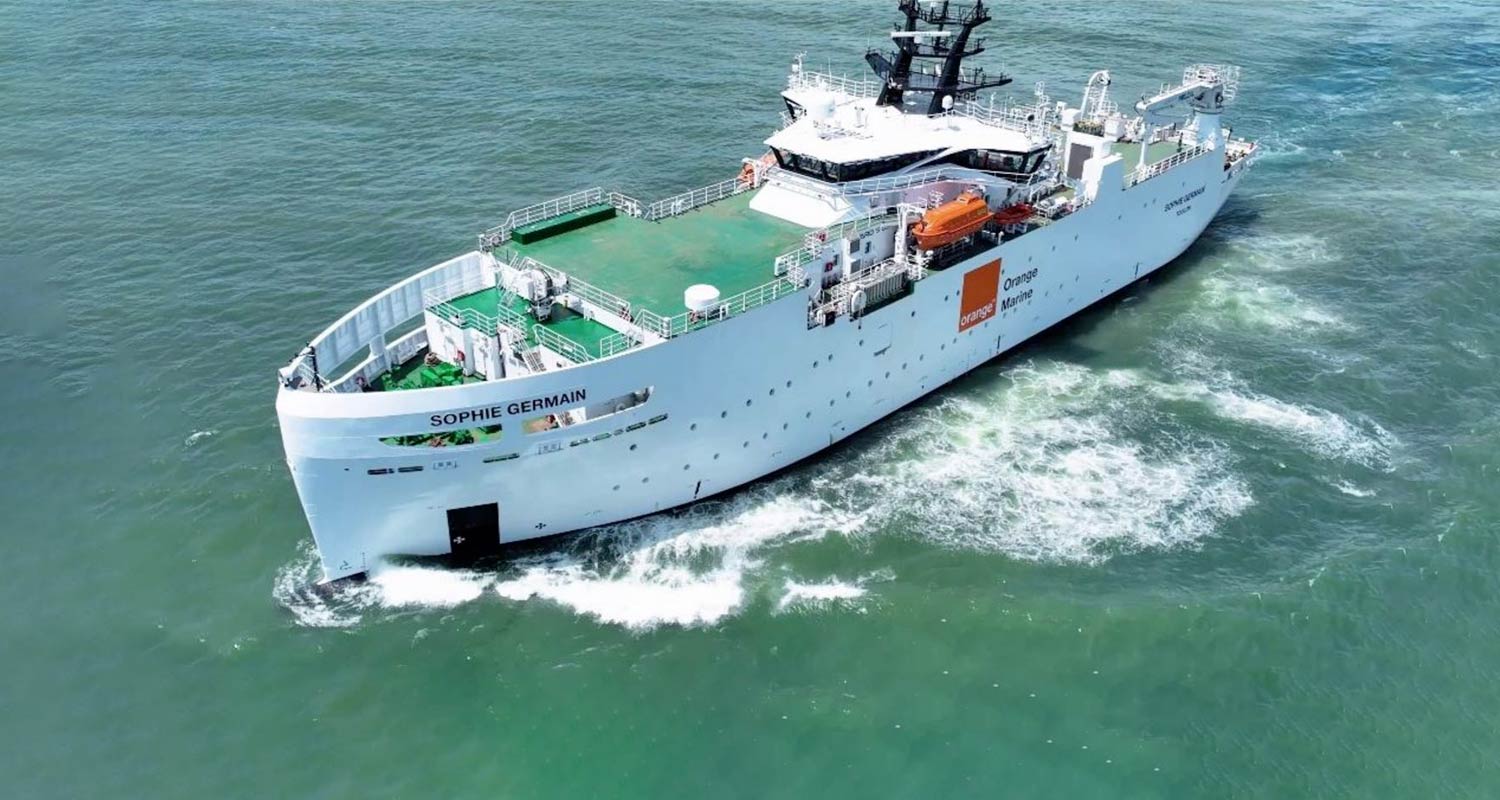
Orange Marine has begun renewing its own fleet. Its €50-million (about R1-billion) Sophie Germain, in service since 2023, repairs cables in the Mediterranean and Red Sea – including North and East African routes – but is stationed in the south of France.
More significantly for South Africa, the company in November 2025 ordered two new hybrid-powered cable ships from Sri Lanka’s Colombo Dockyard to replace the 43-year-old Léon Thévenin and the Italy-based Antonio Meucci. Delivery is expected only in 2028 and 2029, however, meaning no relief for Africa for at least another two years.
“The ageing of the cable ship fleet is a major concern for all players in the submarine cable industry,” Orange Marine president Didier Dillard said at the time.
Yet amid the gloom, South Africa is a standout performer. Citing ICPC repair data covering 2007 to 2024, the report found the country has the world’s shortest “commencement time” – the gap between a fault occurring and a repair vessel mobilising.
“The fastest responders, such as South Africa (1.95 days) and the UK (3.66 days), benefit from proximity to cable depots and streamlined permitting processes,” it said. The global median is eight days; the global average, skewed by extreme outliers, is 22.7 days.
South Africa is also singled out, alongside the Netherlands and the UK, for its pre-authorisation arrangements for repair vessels, which shorten administrative delays when cables break. And Google’s Equiano cable, which landed at Melkbosstrand in 2022, is held up as a best-practice example of open access “reducing regulatory uncertainty and certification costs”.
Case studies
The region’s own outages feature prominently as case studies. The report cited the dual cable breaks of 2020 and 2023, caused by rockfalls in the Congo Canyon, which left South African users with severely throttled connectivity that “disrupted financial markets, cloud services and cross-border data flows”. It flagged the Congo River system as an area where climate change could make submarine landslides more likely.
Read: Google plots E Cape as southern anchor of four-hub Africa network
It also pointed to the March 2024 event in which four cables were severed off West Africa, disrupting connectivity to 12 countries along the continent’s western coast, with one country alone – Nigeria, according to the report’s sources – losing an estimated $590-million (R9.7-billion) over four days. That economies survived these incidents at all, the report noted, was thanks to route diversity and rerouting – as African ISPs demonstrated. The losses, it added, “vastly outweigh the annualised cost of deploying redundancy cable infrastructure”. – © 2026 NewsCentral Media

