

For years, personalisation has been built on a simple promise: define a segment, map a journey, and deliver a tailored experience. That model still exists, but it is starting to break under the increasing complexity of digital behaviour. In 2026, the shift is moving away from more personalisation towards AI-managed digital experiences that continuously adapt in real time.
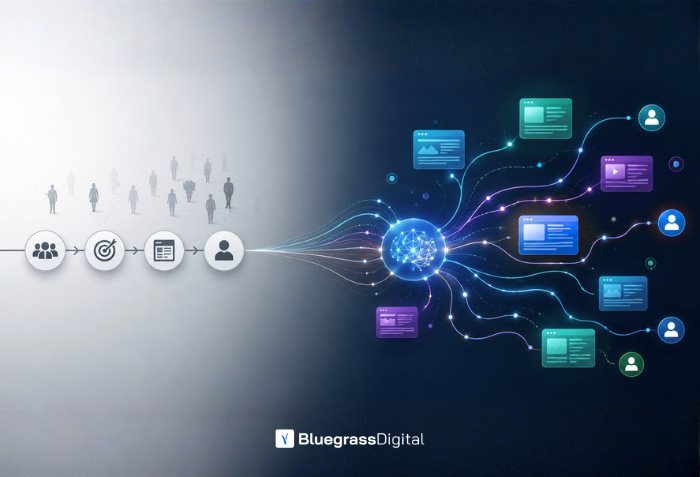
For marketing teams, this is creating a growing gap between how personalisation is designed and how audiences actually behave. Journeys are no longer linear or predictable. They are fragmented, continuous, and shaped by multiple touchpoints that rarely follow a predefined path.
Digital personalisation has traditionally focused on delivering the right content to the right audience segment. In practice, most organisations still rely on segmentation models that group users and deliver tailored variations of the same core experience.
The challenge has never been the value of personalisation. It has been the ability to operationalise it at scale. That is where the next shift in digital experience platforms becomes important.
The rise of AI-managed experiences
Across modern digital experience platforms, a shift is emerging from static segmentation models to AI-managed orchestration layers. For marketing teams, this means moving from manually defined audience rules to systems that assemble and adjust experiences based on live behavioural and contextual signals.
These systems connect content structures, audience intelligence, and behavioural data in real time to shape experiences as users engage. The result is not just more personalised content, but experiences that can reconfigure themselves based on how audiences actually interact.
This direction is increasingly reflected in platforms such as Optimizely, where AI capabilities are being embedded across content, experimentation, and personalisation workflows, supported by agent-based systems such as Opal that enable orchestration across marketing and experience management functions.
Rather than simply adding more layers of automation to existing campaign structures, this represents a more fundamental shift in how experiences are designed and managed.
“What we are seeing with clients is a clear shift away from managing campaigns and towards designing adaptive systems,” says Nick Durrant, MD at Bluegrass Digital. “The challenge is no longer content production; it is orchestrating experiences that respond intelligently in real time while still maintaining governance and brand control.”
This is not the same as generative AI producing more content. The shift is operational, not creative. It changes how marketing experiences are structured, assembled, and continuously optimised within the system itself.
What changes for marketing teams
In some cases, this is extending into tailored landing experiences or microsite-style structures for specific audiences or accounts, which evolve as underlying data and content changes.
For marketing teams, this changes the role of personalisation. It is not only about defining segments and creating campaign variants. It is increasingly about designing the systems, governance, and content structures that allow experiences to adapt safely at scale.
As this model develops, governance becomes more critical, not less. Brand consistency, content accuracy, and measurement frameworks must operate within more dynamic environments where experiences are continuously adjusting.
From campaigns to systems
The direction of travel is clear. Personalisation is moving from a campaign-based marketing capability to an embedded system function within digital experience platforms.
Organisations that gain advantage will not be those producing more personalised content. It will be those that design systems capable of assembling, adapting, and governing experiences continuously, without losing control of brand, accuracy, or intent.
In this context, personalisation is no longer simply a campaign strategy for marketing teams. It becomes part of the operating model of the digital experience platform itself.
For organisations navigating this shift, success will depend less on adopting new AI capabilities and more on building the content, governance, and digital experience foundations that allow them to operate effectively at scale.
Bluegrass Digital
Bluegrass Digital is a digital experience consultancy that helps organisations create, optimise, and evolve enterprise digital experiences. An Optimizely Silver Solution Partner, Bluegrass specialises in digital experience platforms, customer experience, and AI-enabled digital transformation.

