

Bamba Lo, co-founder and CEO of PAPS
Interview with Bamba Lo
CO-FOUNDER AND CEO, PAPS
Lives in: Dakar, Senegal
Bamba Lo founded logistics company PAPS after observing that while businesses in Dakar could successfully sell products, inadequate delivery infrastructure meant those goods frequently failed to reach buyers. To solve this local delivery gap, he started the company with two scooters and a Facebook page.
Today, PAPS serves nearly 90% of Senegal’s banking sector, moves goods across borders in a region where addresses do not always exist, and operates a partnership with UPS. In 2024, Lo was one of the top 20 finalists in the Africa’s Business Heroes entrepreneurship competition.
In this interview, Lo discusses the realities of building a logistics network from scratch.
What challenges does PAPS solve for its clients?
We tried the delivery options available in Dakar at the time. None of them worked the way a business actually needed them to. No tracking, no accountability, no consistency. The client would wait. The package would arrive late, or not at all. The sale was lost. That is the moment I understood: the problem was not selling. The problem was the infrastructure that should turn a sale into a delivery. That infrastructure simply did not exist. And if you are in West Africa trying to build a real business, that is a fundamental blocker. So we decided to build it ourselves starting with two scooters.
Before PAPS, I was running a call centre, selling subscriptions and doing outbound sales. We were decent at generating interest. But then something kept happening: customers would say yes, they would want the product, and then they just would not show up. Not because they changed their minds. Because they could not get to us, and we could not get to them. PAPS is the infrastructure that makes commerce work in Africa. When a business needs to get something from point A to point B – whether that is across a city, across a country, or across a continent – we make that happen reliably, with visibility, with one point of contact. The problem we are solving is fragmentation. In most markets, a company has to stitch together five or six different providers: one for storage, one for last-mile delivery, one for customs, another for cross-border freight. Each one is a separate contract, a separate invoice, a separate phone call when something goes wrong. And when things do go wrong – and in logistics, they will – no one takes responsibility. We have replaced all of that with one integrated stack: storage, pick and pack, last-mile, intercity freight, cross-border, customs. One platform – MyPaps – so clients have visibility across everything. One team they call. One partner accountable for the result. That is PAPS.
What were the initial hurdles you faced after launching PAPS in Dakar?
The early days were humbling in the best possible way. We started with two scooters and a Facebook page. My co-founders and I were doing deliveries ourselves – physically on the road, learning the city, learning what could go wrong.
The first challenge was the most basic one: addresses. In Dakar, as in most West African cities, formal addresses barely exist. Your delivery instruction might be: “third house past the big mango tree on the left.” That is not a joke – that’s the reality. So before we could build any kind of tech-enabled logistics, we had to solve a human, cultural, geographic problem first.
The second challenge was trust – both from clients and from the Papsers, our independent delivery riders. Businesses did not believe we could be consistent. Papsers did not know whether we could pay fairly. We had to earn everything, every day, through execution. There were no shortcuts. But those early constraints were instructive. They forced us to build for the actual reality of our market – not for some idealised version of it. That is still how we operate today.
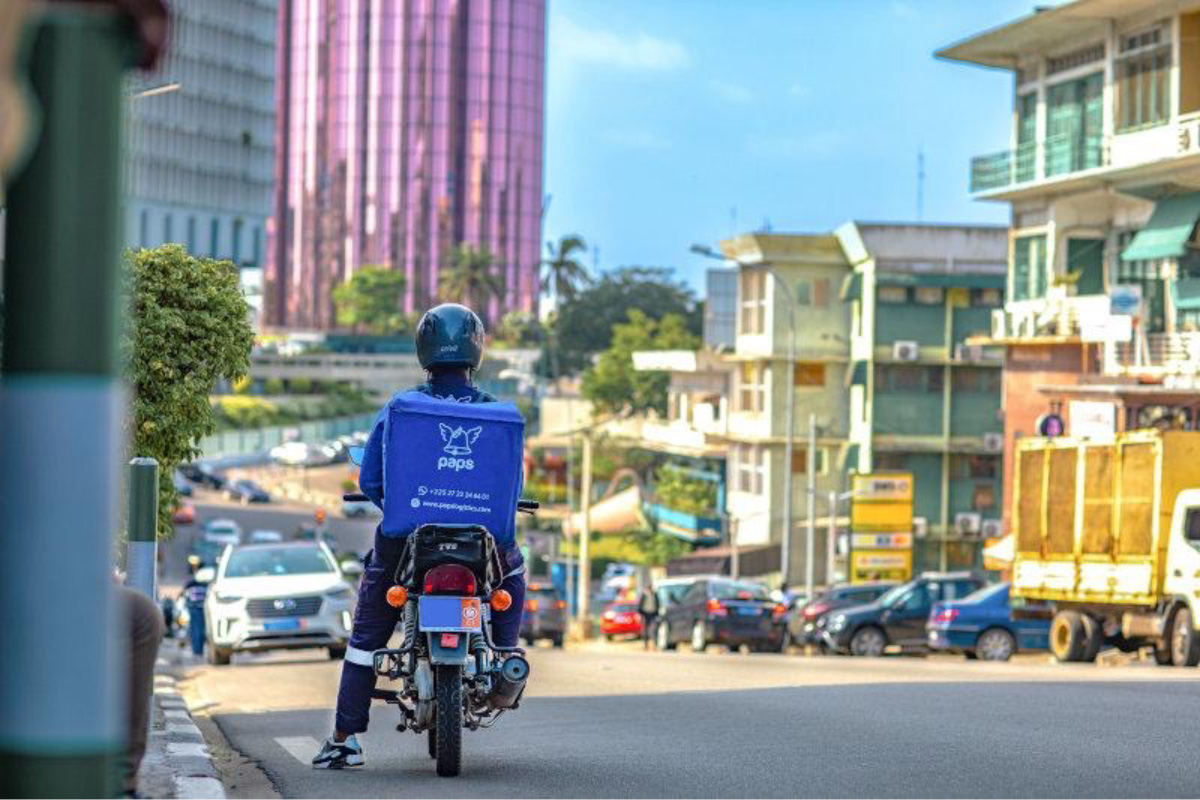
A PAPS delivery driver.
Why did you decide to commit to solving this specific problem?
I think people underestimate logistics because they do not see it. When it works, it is invisible. You order something, it arrives. You do not think about the chain that made that happen. But when it does not work, it costs everyone – the business loses a client, the client loses trust in the whole ecosystem, and commerce slows down. What made me believe this was worth everything? The size of the gap. In West Africa, an estimated 80-90% of retail still happens informally – in part because the infrastructure to support formal trade is missing. E-commerce cannot scale if delivery is unreliable. A bank cannot distribute cards if last-mile execution fails. A pharmaceutical company cannot ensure medicine reaches patients in the rural areas without a cold-chain-capable partner. Logistics is not glamorous. But it is the foundation of everything. If you fix the infrastructure, you unlock trade. You unlock growth. You unlock inclusion. That is not a small bet – that is one of the highest-leverage problems you can work on in this region.
Explain the main turning point for the company.
There were a few, but the most important one was the decision to stop being a delivery company and start building infrastructure. In our early years, we were very good at last-mile. But as we worked more closely with larger businesses, we saw that their logistics problem did not start at delivery – it started at storage, at planning, at customs, at cross-border. They needed someone to own the whole chain, not just the final kilometre. So we made a deliberate choice to build upwards and outwards: adding warehousing, adding international freight, adding a proprietary tech platform. It cost us more, it was harder, it slowed some things down. But it is what transformed PAPS from a local courier into a real logistics infrastructure company.
The second turning point was our partnership with UPS. That gave us credibility at an international level, access to more than 220 countries for our clients, and a signal to the market that PAPS operates at a different tier. It changed how conversations started.
Highlight some of the main difficulties of expanding your network across borders.
The hardest part is that there is no copy-paste. What works in Dakar does not necessarily work in Abidjan. What works in Abidjan does not automatically work in Cotonou or Luanda. Each market has different regulatory frameworks, different infrastructure quality, different payment behaviours, different client expectations. The mistake a lot of companies make is to expand before they have truly understood the new market. They export their model and wonder why it does not land. We have tried to resist that temptation – to arrive with humility, build local partnerships, understand the specific constraints before we scale. What I have learned is that the fundamentals transfer, but the execution has to be local. The brand values, the tech stack, the standards – those are consistent. But how you recruit Papsers in Ouagadougou, how you handle customs in Cotonou, how you build trust with an enterprise client in Abidjan – that requires local intelligence.
Where does technology have the greatest operational impact on the business?
“Digitising logistics” is one of those phrases that can mean everything and nothing. For us, technology has to solve real operational problems – or it is noise. In practice, the biggest impact is in three areas.
First, visibility: our clients can see in real time, through MyPaps, where their shipments are, what is in their warehouse, what their performance metrics look like. Before PAPS, they were calling drivers on WhatsApp. That is not a system – that is improvisation.
Second, dispatching. PapsOps, our internal operations tool, allows us to optimise routes, assign missions, and manage our fleet in a way that would be impossible manually at our current scale. We can plan dozens of runs simultaneously, and adapt in real time when something changes.
Third, the Papser App – our platform for independent Papsers. It gives them clarity: what mission, what route, what payment. That clarity drives performance. A Papser who knows exactly what he is doing and what he earns is a Papser who delivers well.
Logistics involves many moving parts – transporters, customs, clients. How do you build trust in a system where so many things can go wrong?
You build trust by not pretending that things will not go wrong. They will. A package will be delayed. There will be a customs issue. A client will have an urgent request at 9pm. The question is: what happens when something goes wrong? For us, trust is built through two things: transparency and ownership. Transparency means the client is never in the dark. MyPaps gives them visibility. If there is a delay, they know about it before they have to call us. And when they do call, they reach a real team that has context on their operations. Ownership means that when something goes wrong, PAPS owns it. We do not blame the transporter. We do not tell the client to sort it out with customs. We are the single point of accountability. That is a commitment we take seriously – and it is also what separates us from a marketplace model where no one is truly responsible. Trust in logistics is not built with marketing. It is built delivery by delivery, shipment by shipment, over time. We have clients who have been with us since 2017. That is the real proof.
Can you share a real example of how PAPS has changed things for one of your clients?
I think about one of our banking clients – today we work with nearly 90% of the banking sector in Senegal. When we first engaged with banks, their card and document distribution was a real problem: sensitive materials delivered by informal couriers, no tracking, no proof of delivery, significant security risk. After implementing PAPS, they had a dedicated team, documented proof of delivery, SLA commitments, and a dashboard to monitor performance by branch. The operational risk went down significantly.
More broadly, I have seen what reliable logistics does for e-commerce businesses. When delivery works, returns go down, reviews go up, repeat purchases increase. When it does not, one bad experience can destroy a brand’s reputation. The first-attempt delivery rate is not a logistics metric – it is a business metric.
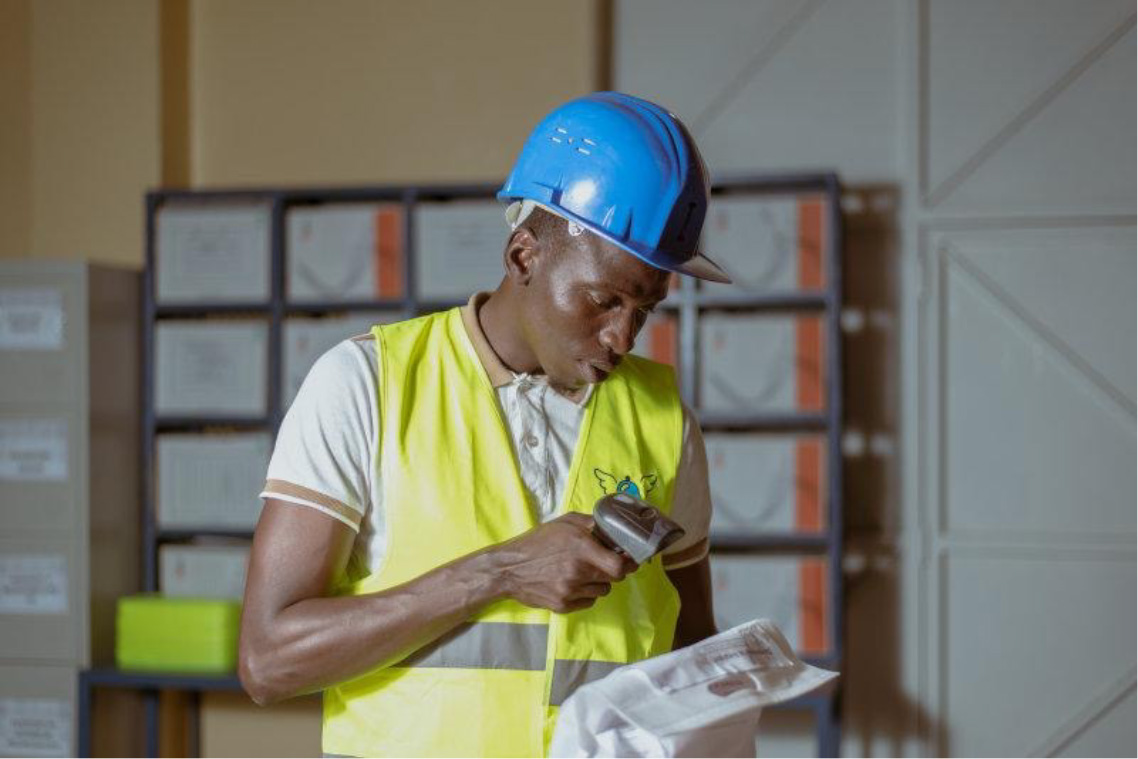
PAPS offers a range of logistics services.
What has been the most difficult part of building PAPS?
The early years of expanding outside Senegal were harder than we expected. When you have built something that works well in one market, there is a natural confidence that transfers. But that confidence can make you less careful, less patient – and expansion punishes impatience. We had moments where we moved too fast, where the operational infrastructure was not ready to support what we had promised clients. Where we underestimated the complexity of a new regulatory environment or the time needed to build the right local team. What that taught us – and what shapes how we operate today – is that excellence in one market has to be earned again in every new market. We now go into expansion with more structure: proper due diligence, a phased approach, local partnerships built before the commercial launch. We are more patient. Sustainable growth is slower – but it is the only kind that lasts.
What are some of the business lessons you have learned while building the company?
That the infrastructure problem comes before the technology problem. I see a lot of founders rush to build apps, to digitise, to automate – before the basic operational infrastructure is working reliably. Technology amplifies what you have already built. If the fundamentals are not solid, tech will just make your failures faster and more visible.
The second thing: do not underestimate the cost of trust. In markets where formal systems are weak, relationships and reputation are the real infrastructure. Your first 50 clients will decide your next 500. How you handle a problem at 11pm on a Friday will be talked about. Building a logistics company in Africa is partly a relationship business – and you cannot outsource that.
And the third, which I believe deeply: the market is bigger than anyone thinks. The informal economy is not the enemy – it is the addressable market. Every informal trade flow that formalises is an opportunity. PAPS exists to be the infrastructure that makes that formalisation possible.
What does success look like to you?
For PAPS specifically: success looks like being the logistics layer that any serious business in West Africa – and eventually across the continent – trusts as default. Not because we are the only option, but because we are the most reliable, the most integrated, the most connected to the global network. A company should not have to think about logistics. They should think about their product, their clients, their growth – and trust PAPS to handle the rest.
At a larger scale, success for African trade looks like the removal of the infrastructure tax that every business currently pays. Today, logistics friction is a hidden cost that slows growth, reduces competitiveness, and keeps businesses smaller than they should be. When that friction goes down, commerce accelerates. When commerce accelerates, economies grow. When economies grow, opportunities multiply. We are not there yet. But I believe this generation of African infrastructure builders – in logistics, in fintech, in energy – is laying a foundation that will change what is possible on this continent. PAPS wants to be an essential part of that foundation. That is what keeps us going.
This article is an adapted version of a piece originally published by Africa’s Business Heroes.

