

Questions arise over Chinese firm’s Sh50 Billion Lamu Port dredging as container ship runs aground
The MV Baltimore Express at the Port of Lamu. PHOTO/KPA.
By MARITIME CORRESPONDENT
Questions have arisen over the dredging of the Lamu Port channel after a ship ran aground before it was lightened and subsequently managed to berth on Sunday.
The MV Baltimore Express, a colossal vessel measuring 369 metres in length overall, arrived at Lamu Port from Oman’s Salalah Port. KPA’s General Manager at the Port of Lamu, Capt. Abdulaziz Mzee, who is also a ship captain, took charge of the vessel after it ran aground, ensuring some cargo was offloaded before steering it safely into the port.
According to a maritime official familiar with the case, the ship called at the Port of Lamu to offload what was described as suspicious cargo loaded at Oman’s Salalah Port when the incident occurred.
The vessel left the Port of Lamu today after surveyors contracted by its owners, the German shipping line Hapag-Lloyd, completed an assessment of the damage sustained during the grounding.
Hapag-Lloyd is expected to file a compensation claim with the vessel’s insurers, a claim likely to result in the Kenya Ports Authority (KPA) paying billions of shillings in compensation.
Surveyors are keen to establish why the ship, which has a draught of 16.5 metres, ran aground despite the Port of Lamu reportedly having a depth of between 17.5 and 18.5 metres.
The MV Baltimore Express is said to be the third ship to run aground at the Port of Lamu since its opening to public use. This development has raised questions as to whether the company contracted to dredge the three operational berths met its contractual obligations.
The contract for dredging the three berths at Lamu Port was awarded to China Communications Construction Company (CCCC) in August 2014 at a cost of US$478.9 million (Sh49.7 billion).
This dredging contract was part of the broader Sh2.5 trillion (US$5 billion) Lamu Port-Southern Sudan-Ethiopia Transport Corridor (LAPSSET) project, which launched in 2012 during former President Mwai Kibaki’s administration.
The Lamu Port project was designed to include 32 deep-sea berths at an estimated cost of US$5 billion. The short-term plan, covering the first three berths currently in operation, was estimated at US$689 million.
This cost accounted for dredging and reclamation, construction of berths and yards, revetment, causeways and roads, buildings and utilities, as well as the procurement of equipment and tug boats.
It remains unclear why KPA issued a statement claiming that the MV Baltimore Express berthed without incident, contrary to reports from port officials, shipping operators, and other maritime authorities.
“In a historic feat, the Port of Lamu on Sunday evening welcomed the largest vessel ever to dock at any port in East and Central Africa. The MV Baltimore Express, a colossal vessel measuring 369 metres in length overall, arrived from Oman’s Salalah Port,” KPA said in a statement.
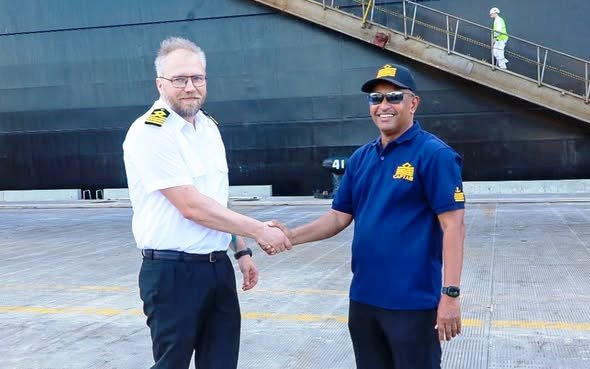
The Captain of MV Baltimore Express with KPA’s General Manager at the Port of Lamu, Capt. Abdulaziz Mzee. PHOTO/KPA.
The statement added that the vessel, operated by German shipping line Hapag-Lloyd, handled the repositioning of dangerous cargo in compliance with International Maritime Organization (IMO) regulations during its stay at the port.
The call by MV Baltimore Express followed an earlier record set by a sister vessel, the MV Nagoya Express, a 335-metre container ship, which docked at the Port of Lamu in August 2025. Capt. Mzee, welcomed the ship, highlighting Lamu’s proven ability to handle ultra-large vessels.
“This call lifts Lamu’s profile on the global maritime map and compares to some of the world’s most developed ports, including Singapore, Rotterdam, and Hamburg,” said the GM.
The KPA statement added: “What sets the Port of Lamu apart from other regional ports is its naturally deep harbour of 17.5 metres. This depth allows Panamax and post-Panamax ships to sail into the channel with minimal or no dredging. Many other African ports require constant dredging to deepen the seabed enough to accommodate mega ships and remain competitive.”
KPA further asserted: “This natural advantage enables Lamu to rival the world’s most modern ports, positioning it not only as a transshipment gateway but also as a strategic hub capable of handling very high cargo volumes.”
Lamu has handled over 120 vessels since the start of the year, with more expected in the coming weeks. To support this growth, KPA is investing in modern equipment, with new cranes, terminal tractors, and other cargo-handling apparatus expected to arrive throughout the year.
Safety in harbours remains a crucial aspect of maritime operations, as these areas often experience dense traffic, including commercial vessels, fishing boats, and recreational craft. Properly dredged channels are vital to maintaining safe navigation.
Ships that run aground may suffer hull damage, flooding, or loss of cargo, while also obstructing other vessels and delaying port operations.
Environmental risks are also elevated, as groundings can result in oil spills or the disruption of sensitive marine habitats. Regular hydrographic surveys, accurate charts, and scheduled dredging are essential to mitigating these hazards.
The International Maritime Organization (IMO) emphasises the importance of port safety and provides guidelines to reduce the risks associated with groundings and other navigational incidents.
While the IMO does not prescribe a universal compensation scheme, it recognises that ships damaged due to inadequate port maintenance or poor navigational aids may be entitled to seek redress under international law or local port regulations.
Many ports worldwide implement statutory liability rules or insurance mechanisms to ensure that vessel owners can recover losses where negligence, such as insufficient dredging, contributed to an incident.
Such measures incentivise ports to maintain safe navigation channels and adhere to international safety standards, reinforcing both operational reliability and environmental protection.
